

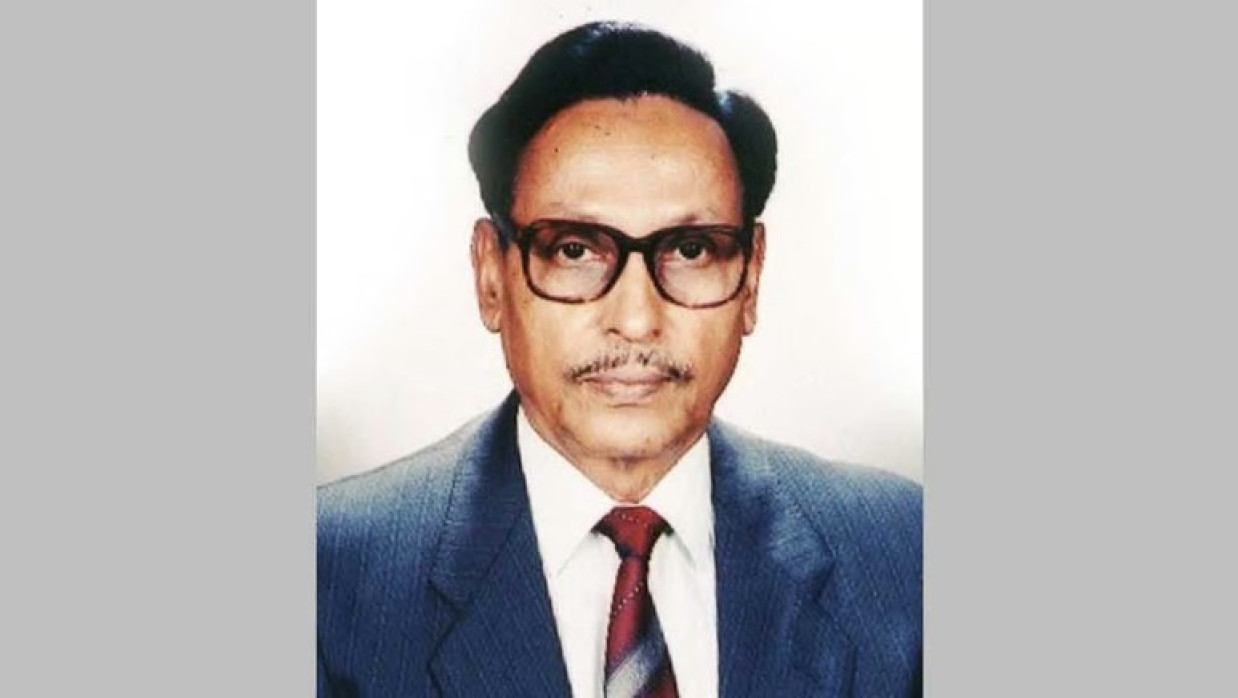
Major General (Retd.) Mohabbat Jan Chowdhury died on 24 August 2026 at the age of 92 at Combined Military Hospital in Dhaka. He was a Bangladesh military leader and held several political positions, including Minister of Home Affairs, Minister of Food, and Member of Parliament. Chowdhury had played an important role in Pakistan's political turmoil, Bangladesh's independence war of 1971, and the formation of the new government.
Chowdhury is survived by two sons and other relatives. His wife predeceased him. He belonged to the traditional Chowdhury family of Khanpur village in Muksudpur upazila of Gopalganj district. According to family sources, he was to be laid to rest at Banani Cemetery in Dhaka.
Commissioned into the Pakistan Military Academy in 1955, Chowdhury had a long, significant military career focused mainly on communications and intelligence. After Bangladesh gained its independence, he held various high-ranking positions, including Deputy Director General of the Bangladesh Rifles and Director of Signals at Army Headquarters. On October 8, 1977, he became the Director General of the Directorate General of Forces Intelligence (DGFI) and stayed in that role until his retirement on August 18, 1982.
During Chowdhury's time in DGFI, Bangladesh faced a critical time in its history. In the years after Bangladesh's political turmoil of 1975, the country faced many military coups, civil disorder, and uncertainty about its political direction. As Bangladesh was trying to form itself as a country with governance and infrastructure, it was heavily crippled by political division between political parties as well as within the military itself.
In an interview about Bangladesh during this time, Chowdhury said he worked tirelessly to ensure Bangladesh's stability and keep its military united. He felt that India's intelligence agency RAW took advantage of political turmoil and divisions within Bangladesh. Chowdhury described his dealings with RAW as a "battle of wits".
He felt that Bangladesh was at a disadvantage. India had more assets, a bigger intelligence network, and regional reach. Bangladesh was still rebuilding after the devastation of the Liberation War and the political instability that followed. Chowdhury felt DGFI needed to increase intelligence collection and analysis capabilities and thwart foreign influence efforts.
Concerns about safety increased due to armed activities occurring near parts of the Bangladesh-India border. One group that opposed the government after 1975 was the Kaderia Bahini, led by Abdul Kader Siddiqui, a well-known leader during the 1971 Liberation War. Cross-border movement, political violence, and divided loyalties made it difficult for the government and security forces to maintain order in the area.
Chowdhury’s interpretation of these developments was closely connected to his support for President Ziaur Rahman’s political vision. He believed that Zia’s emphasis on Bangladeshi nationalism, economic development, national cohesion and an independent foreign policy attracted considerable public support. In his view, a united population and a disciplined military would be better prepared to resist external manipulation than a politically fragmented nation.
Memoirs by those who served in sensitive national security positions can sometimes provide valuable information. However, one should take such information with a grain of salt. Secrecy still surrounds many operations from that time. Additionally, official documents related to certain events may be difficult to locate. Different agencies working on the same issue may have varying accounts depending on their agenda and point of view. Moreover, one person's story can be skewed based on their political alliances and the current political climate. For this reason, I paired Chowdhury's stories with declassified documents, US diplomatic cables, and accounts from other actors involved in the events described.
After retiring from the military, Chowdhury joined the civil service and ran for Gopalganj-1's parliamentary seat in 1986. He lost the election to Awami League candidate Sheikh Hasina. He later won a seat in Parliament from Faridpur-3 and began working in the government under President Hussain Muhammad Ershad. Chowdhury served in several important capacities, including the Ministry of Home Affairs, food drives, and relief work.
Chowdhury also held important civilian and financial appointments. He served as chairman of Bangladesh Krishi Bank and the Bangladesh Public Administration Training Center and was associated with Micro Industries Development Assistance and Services, better known as MIDAS. These responsibilities showed a career that spanned military command and intelligence, banking, administration, development, and national politics.
Mohabbat Jan Chowdhury was a Major General and a controversial political figure in Bangladesh. Judging leaders like Ziaur Rahman and Hussain Muhammad Ershad has remained divisive and controversial to date. Judging Major General Chowdhury requires understanding both his service to the nation and the politics of the time.
One lesson that we can take away from his life and times is that, as a small state, Bangladesh must have strong institutions to protect itself from powerful neighbors. While security concerns should never be taken lightly, conspiracies often stem from fear. When a state is weakened by poor management or fighting within itself, be it political leaders or political institutions, it leaves the state vulnerable. This can allow other countries to play politics within our borders.
Bangladesh can’t control being a small state in South Asia, but we can ensure our institutions are strong. Major General Mohabbat Jan Chowdhury’s career in the military, intelligence agencies, Parliament, and government shows us one thing: safeguarding a nation’s sovereignty doesn’t rely only on its borders. It relies on staying united as a nation, maintaining professional institutions, promoting economic development, learning from our past, and fostering patriotism that serves the country's best interests.

0 Comments
LEAVE A COMMENT
Your email address will not be published