

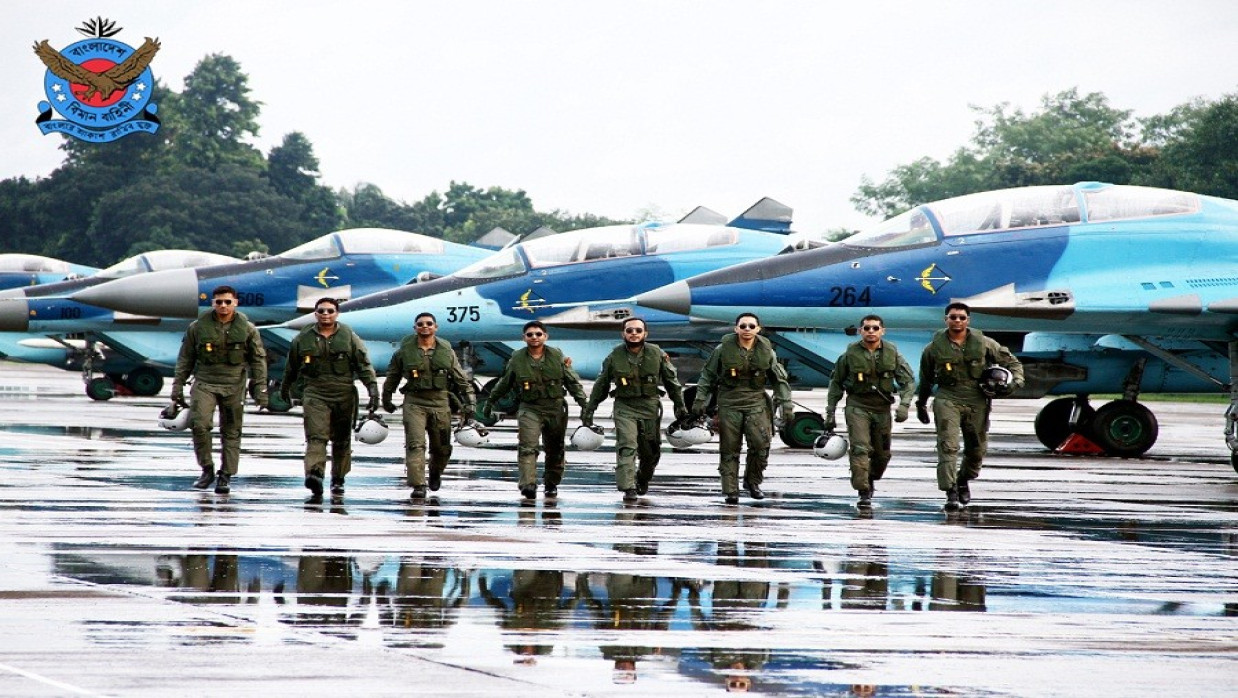
When we think of the Bangladesh Air Force, we tend to envision fighter jets, transport aircraft, helicopters, radar networks, and land-based air defense. One capability that does not always get enough attention is a specialized ground-combat role that the BAF has been developing. According to new information, it now appears that the Bangladesh Air Force has formed a unit called the 501 Air Regiment, which seems to be further development of the Air Force's capacity to protect its aviation assets, assist in airborne operations, and fight on the ground if necessary.
Little else is known of the regiment. The Bangladesh Air Force has released a procurement letter that explicitly mentions the "AOC 501 Air Regt BAF", which is firm institutional evidence that the regiment has indeed been formed. However, many other reports circulating in the local press as to its exact size, commanders, wings under its charge, and offensive duties have not been officially confirmed by either BAF or ISPR. Such claims ought to be considered tentative.
From Airbase Security to Specialized Operations
501 Air Regiment would seem to be an organic development of assets that had been publicly associated with No. 41 Squadron Airborne. Recall that squadron was reported to have ground personnel trained to operate in a support role with fixed-wing and rotary aircraft. A regiment implies a larger command structure and possibly a wider area/mission scope.
Its likely primary responsibility is force protection: defending airbases, radar stations, aircraft, missile batteries, fuel installations and command centers against sabotage, terrorism, drone attacks and hostile special forces. Modern air power depends on expensive but vulnerable infrastructure. A combat aircraft is ineffective if its runway is damaged, its fuel supply disrupted or its pilots and maintenance personnel cannot operate securely.
The regiment could also be assigned to recover seized airfields, secure forward landing zones, protect transport aircraft during austere operations and support the evacuation of downed aircrew. Airborne and helicopter-borne personnel may assist in combat search and rescue, casualty evacuation and the rapid reinforcement of isolated military positions.
This mission differentiates the unit from the Bangladesh Army's Para Commando Brigade and the Navy's Special Warfare Diving and Salvage, or SWADS, force. The Army remains responsible for major land-based special operations, while SWADS specializes in maritime counterterrorism, underwater operations and naval reconnaissance. The Air Regiment's distinctive purpose would be to connect ground combat with air mobility and the protection of air-power infrastructure.
Unconfirmed rumors suggest that there are three tactical squadrons within the regiment located at Dhaka, Chattogram, and elsewhere. Also unconfirmed rumors are that it is led by an air commodore (name) or that it is currently stationed at BAF Base Bashar, Tejgaon. Do not assert as fact until officially announced. The existence of 501 Air Regiment can be documented; further internal structure and operating procedures are not public knowledge.
Training and International Cooperation
Bangladesh has gradually developed the training infrastructure needed to build such a force. Members of the U. S. Air Force's 353rd Special Operations Group worked with the BAF on Exercise Teak Buffalo in Kurmitola in 2008. While reporting did not reveal the Bangladeshi unit involved or what it trained on, officials did report a budding special-operations relationship between the two air forces.
Subsequent exercises have focused on tactical airlift. At Cope South 20¼4, Bangladeshi and U.S. service members conducted low-altitude flight training, tactical parachuting, air-land integration, aircraft recovery, aeromedical exercises, and airlift planning. All of these skills have applications for inserting commandos, delivering supplies to forward positions, and extracting people from remote places.
Bangladesh's Evolving Air Doctrine
Bangladesh has yet to release a stand-alone air-power doctrine, unlike some of its larger counterparts. Therefore, Bangladesh's doctrine must be gleaned from its exercises, acquisitions, force structure, and stated defense priorities.
One would gather that the doctrine at play here is still very much defensive in nature, territorial, and joint-service. Operating to defend Bangladesh's territorial airspace, major population centers, seaports, military bases, power grids, and other strategic assets. There is currently no means to employ tanker aircraft, long-range bombers, or extensive expeditionary support elements to enable prolonged power projection well beyond its borders.
Air defense integration is one component. Fighter jets, radar installations, surface-to-air missiles, and their command-and-control systems have to operate as a single entity. WINTEX-2022 featured BAF fighter jets, transport aircraft, helicopters, and missile units operating from various locations across the country. ISPR said the exercise evaluated existing combat potential, identified gaps, and provided recommendations to enhance capabilities.
Mobility and speed are the second aspect. Bangladesh's situation is geographically challenging, with little room to maneuver because of the many rivers, which give you very little strategic depth; your exposure to cyclones/flooding means you need airlift capabilities. Planes and helicopters move men, equipment, and humanitarian supplies to areas where roads, bridges, or ports have been destroyed or are inaccessible. An Air Regiment would also provide you with a security element you can deploy to protect your aircraft and landing zones.
Joint warfare is the third pillar. The BAF must support the Army and Navy through reconnaissance, troop transport, close air support, maritime surveillance, casualty evacuation and airborne deployment. The 501 Air Regiment could strengthen this relationship by preparing forward airfields and coordinating air-ground operations.
Humanitarian assistance and peacekeeping form another important dimension. BAF aviation units have supported United Nations missions, including a decade of demanding operations in Mali.
The 501 Air Regiment should not automatically be interpreted as evidence that Bangladesh is adopting an aggressive doctrine or preparing operations against any particular neighbor. Its creation is better understood as a response to contemporary threats and a recognition that aircraft, radars and missile systems require specialized ground protection. If properly integrated, the regiment will complete Bangladesh's tri-service special-operations structure while giving the Air Force a sharper capacity for airbase defense, personnel recovery, disaster response and joint operations.


0 Comments
LEAVE A COMMENT
Your email address will not be published