

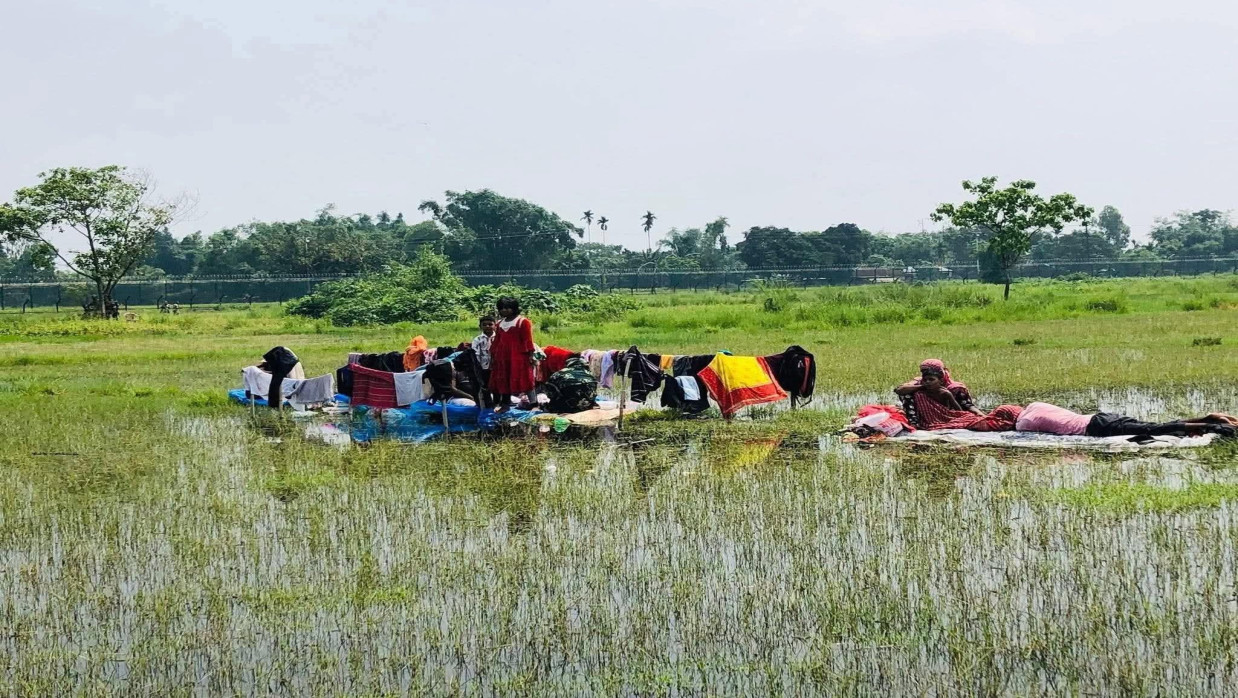
Recent incidents involving the forcible transfer of individuals and families across the India-Bangladesh border have raised serious legal and humanitarian concerns. The most serious concern this report reveals is that some individuals, including women and children, have remained stranded in the no-man ’s-land between the two countries for days. It is also alleged that these people remain there without adequate access to food, water, shelter, or medical assistance. These incidents raise important questions not only about migration control and border governance, but also about the protection of fundamental rights in spaces where responsibility between states becomes contested.
States undoubtedly possess sovereign authority to manage migration and expel those who lack lawful grounds and documents for remaining within their borders. However, international human rights law increasingly stresses that migration control must be exercised in accordance with the ‘rule of law’ and with respect to ‘human dignity’. Therefore, the key question raised by recent reports is whether people can be expelled through informal means that circumvent legal safeguards and create a protection vacuum in which no state is willing to assume responsibility.
Deportation Vs Push-Ins
A distinction should be drawn between lawful deportation and so-called "push-ins." Normally, deportation follows procedures set out in domestic law. These include determining a person's immigration status, verifying their nationality, and coordinating with the receiving state if needed. By following these procedures, it is expected to reduce the risk of error vis-à-vis ensuring that removal decisions are subject to legal scrutiny.
A push-in, by contrast, involves the forcible transfer of individuals across an international border without the legal protections that are associated with deportation. Reports on recent events indicate that some people may have been transferred across the border without deportation orders, judicial scrutiny, or finalized assessment of nationality verification. Even if these reports are not fully substantiated, but they raise serious concerns about the legal procedure and accountability mechanism in the enforcement of borders.
This distinction matters because determining a person's nationality is often a legally and factually complex matter. People may be without documentation, hold contested citizenship statuses, or come from groups that have historically lived on both sides of the border.Therefore, informal removal practices increase the risk that individuals may be expelled before these questions have been adequately resolved.
Human Rights in No-Man’s-Land
The most immediate concern arising from recent reports is the creation of a legal and humanitarian limbo. When individuals are left in no-man’s-land between two states, uncertainty may arise regarding which authorities bear responsibility for ensuring their safety and welfare. Yet the existence of such uncertainty cannot justify the denial of basic human rights.
According to international human rights law, rights attach to individuals by virtue of being human, not their nationality. Among the most basic requirements of human dignity are access to food, drinking water, shelter, healthcare, and protection from inhuman or degrading treatment.
Therefore, serious humanitarian concerns arise on the issue that women and children have remained stranded in border areas without adequate access to these necessities.
The vulnerability of the individuals affected in no-man’s-land is especially important to consider. Children face heightened risks of illness, trauma, and long-term psychological harm when exposed to prolonged uncertainty and inadequate living conditions. Women may face additional security and health risks in border environments lacking effective protection mechanisms. Human rights obligations become especially important precisely when individuals find themselves in situations of extreme vulnerability.
Due Process and Non-Refoulement
Forced push-ins also raise questions about the procedural fairness and the principle of non-refoulement. The principle of non-refoulement forbids states from sending people back to a country where they would face persecution. This principle is regarded as a fundamental rule of customary international law that applies to all states, even if they have not ratified the 1951 Refugee Convention. Though India is not a party to the 1951 Refugee Convention or its 1967 Protocol and lacks a domestic asylum law, but remains bound by the customary international law principle of non-refoulement.
Moreover, India has obligations under the International Covenant on Civil and Political Rights (ICCPR), the Convention on the Elimination of All Forms of Racial Discrimination, and the Universal Declaration of Human Rights (UDHR), which further support this argument. Under Article 9 of the ICCPR, any deprivation of liberty must be lawful, necessary, and subject to judicial review.
Furthermore, non-refoulement applies beyond the formal process of determining refugee status. Summary removals may stop authorities from identifying individuals who need protection or who have special vulnerabilities. For this reason, international courts and human rights bodies have consistently emphasized the importance of individualized assessment before removal decisions are implemented.
In Hirsi Jamaa and Others v Italy (2012), the European Court of Human Rights held that migrants could not be summarily returned without an examination of their individual circumstances. Though this judgment was given within the European human rights system, but it reflects a broader principle that migration control should not be carried out through procedures that deny individuals the opportunity to have their circumstances considered.
The Indian Constitutional Dimension
The legality of forced push-ins must also be examined under India's constitutional framework. Article 21 of the Indian Constitution guarantees the right to life and personal liberty, and the Supreme Court of India has repeatedly held that Article 21 extends to everyone within India's territory, including non-citizens. The Indian Supreme Court also, in Vishaka v State of Rajasthan (1997), affirmed that international norms consistent with constitutional guarantees may be used to guide constitutional interpretation where domestic law is silent. This interpretive approach suggests that debates concerning non-refoulement cannot be reduced solely to questions of treaty ratification.
Though India has often emphasized that it is not a party to the Refugee Convention, but international human rights principles continue to influence the constitutional understanding of life, liberty, dignity, and procedural fairness under Article 21 of the Constitution. The importance of non-refoulement in the Indian context, therefore, derives from both international law and broader constitutional commitments to human rights protection.
Accountability and Regional Cooperation
Accountability is another major challenge. Border incidents often produce disputes over where people were detained, whether actions were lawful, and which authorities were involved. Careful documentation—through independent observation, real-time records, location data, and witness testimony—can help establish facts and ensure that alleged violations are properly examined.
Simultaneously, cooperation and mutual understanding are essential to migration governance between neighbouring countries. Procedures for nationality verification and repatriation reflect the need for careful handling of identity and responsibility. Circumventing these procedures through informal means poses risks to the protection of human rights vis-à-vis inter-state trust and relations.
Conclusion
Reports of forced push-ins at the India–Bangladesh border raise serious concerns that extend beyond migration control. A fundamental question arises regarding human rights: what happens when individuals find themselves in the no-man ’s-land, when both sides refuse to take responsibility for their protection?
The answer should not be that the law ceases to apply between borders. Human rights apply at the border and regardless of citizenship. States may regulate migration, but they must do so lawfully—with dignity, accountability, and protection for the vulnerable.
Migration pressures continue to reshape border governance worldwide. Here, the test for states is to balance between control of human mobility and legal obligations. The treatment of individuals stranded between borders may well measure the depth of their human rights commitment when sovereign interests and human dignity collide.

0 Comments
LEAVE A COMMENT
Your email address will not be published