

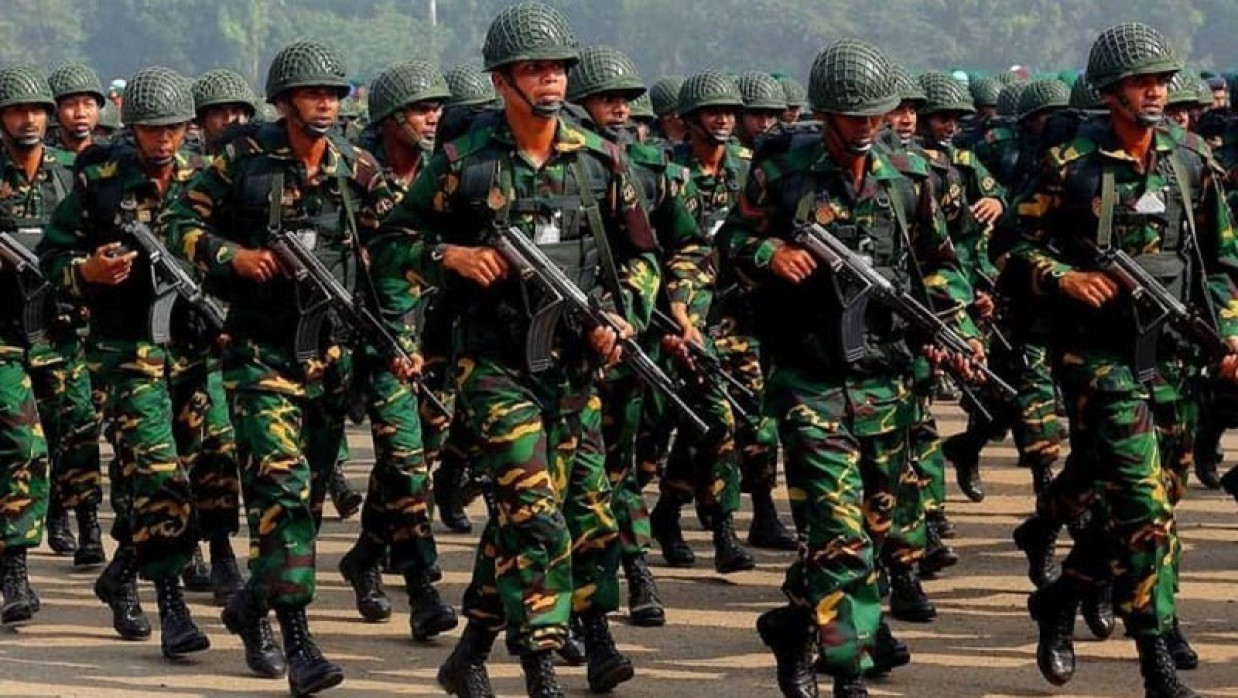
Bangladesh is quietly recalibrating its military posture after 2025, a shift that has gone largely unnoticed outside periods of headline-grabbing defense deals. While Dhaka continues to import platforms and professionalize its forces, what is changing now is the intent behind them. Bangladesh has historically been a peacekeeping-focused and inward-looking military power. Today, it appears to be pivoting towards a posture based on deterrence and maritime awareness, powered by insecurity in a changing regional order.
Domestic political change is intersecting with geopolitical competition in the Bay of Bengal, pushing Bangladesh towards new conceptions of power, insecurity, and sovereignty. The impact on India and South Asia will be profound.
Bangladesh Begins: Legacy of Insecurity
To understand Bangladesh’s strategic mindset today, it is important to remember its origins. Bengali servicemen were barred from command positions, heavy weapons platforms, and strategic military control in pre-1971 East Pakistan. Bengali soldiers made up roughly 5% of the Pakistan Armed Forces by the mid-1960s and were professionally assigned to logistics and technical positions, but were largely kept out of decision-making roles.
The Bengal Regiment-East Bengal Regiment was constituted in 1948 and was never given a full military complement of armor, aircraft, naval assets, or logistical support. West Pakistan maintained direct control over the military might in East Pakistan. Far from being a national defense force, the Pakistan military served primarily as a tool for population control.
In 1971, this power imbalance repeated itself. With limited armor, air support, or navy at its disposal, the Mukti Bahini, a militia born solely out of grassroots resistance, liberated Bangladesh on landings in the east and sheer force of will. It was a lesson Bangladesh has not forgotten: do not be denied again.
Professional, But Not Quite Powerful
Bangladesh achieved autonomy, but independence did not guarantee security. Political instability lasted throughout much of Bangladesh’s post-1971 history, resulting in multiple regime changes via coups, assassinations, and the military’s overt politicization. Strategic thought during this time remained introspective: regime security took precedence over strategic deterrence.
The armed forces of Bangladesh remained peacekeeping-focused in the decades after independence. Bangladesh began to see domestic institutional stability by the early 1990s, and military professionalism grew by leaps and bounds during its active peacekeeping tenure. Today, Bangladesh is among the top troop and budget contributors to UN Peacekeeping Operations. Its military is battle-tested, professional, and respected internationally. However, peacekeeping missions do not make for credible deterrent forces. Bangladesh built a capable force without autonomy of intent.
This began to change with the launch of Forces Goal 2030, a document revisited in 2017 that aimed to guide Bangladesh towards credible deterrence, a transition away from strict peacekeeping operations, and the modernization of its forces with power-projection capability, with an emphasis on naval power.
Between 2019 and 2023, Bangladesh imported $4.5 billion worth of arms, of which over 71 percent originated in China. Platform acquisitions have been heavy: submarines, frigates, main battle tanks, armored personnel carriers, fighter jets, and air defense systems. Bangladesh has cultivated a professional and disciplined military but remains reliant on major power suppliers.
Bangladesh Starts Asserting Itself after 2024
Quantitatively, Bangladesh will continue to expand and improve the size and quality of its forces after 2024. Qualitatively, however, what is changing is the intent behind acquisitions and ambitions. Sheikh Hasina’s departure has ushered in a new political landscape no longer defined by calibrated cautiousness. There will be modernization, but it will come at scale. Dependence on China will grow. Relations with India will need to find a new equilibrium.
After basking in the geopolitical shallows for decades, Bangladesh is beginning to feel threatened. Border disputes have intensified, security and economic competition in the Bay of Bengal is building momentum with new actors, and grey-zone coercion has increased. Militarily, Bangladesh is responding in kind, turning its focus to multi-domain operations that allow for flexible responses on land, in the air, at sea, and in the information domain.
Talk of air-power is shifting from constabulary to denial. Bangladesh is rumored to be acquiring fourth or 4.5-generation fighter jets, as well as layered air defense and over-the-horizon radar coverage to match. Ground forces will continue to prioritize mobility and the acquisition of anti-armor strike capability. And at sea, Bangladesh is looking to gain domain awareness through patrol boats, ocean surveillance, and submarine infrastructure.
Missile technology, UAVs, cyber warfare, electronic warfare, and ISR are particular areas of note. Capabilities in these areas can multiply small militaries many times over. Bangladesh is spending money with this in mind. Bangladesh crossed a defense spending threshold in 2023, passing $3 billion in annual allocations. By 2040, Bangladesh aims to spend roughly $75 billion on defense.
China Invades Bangladesh
China has shifted from partner to enabler. Bangladesh and China have cooperated militarily since 2002, but in recent years, Beijing has taken efforts to deepen this partnership. Bangladesh is China’s fourth-largest arms customer, purchasing approximately 10 percent of China’s global defense exports.
Beyond transactions, what changes after 2025 is access. Chinese state-owned enterprises, such as NORINCO, are looking to establish joint ventures in Bangladesh to maintain and service Chinese platforms. Bangladesh will not only use Chinese submarines and warships, but will also base them at China’s first-ever overseas submarine base.
Pakistan Creeps Back In
If China continues, Pakistan’s return is a break from tradition. Pakistan and Bangladesh suspended military ties for the better part of 50 years after 1971. The past year has seen a resurgence in military cooperation between the two countries.
Military-to-military trainings and exercises have been exchanged, Pakistan is upgrading Bangladeshi armor, supplying ammunition, Bengali officials are touring Pakistani military facilities at an unusually high rate, and most conspicuously, intelligence cooperation is being pursued at a senior level.
Pakistan brings to Bangladesh years of asymmetric conflict experience, an intelligence-heavy security mindset, and a strategic depth doctrine. How this will play into Bangladesh’s own security perspectives on India and autonomy remains to be seen.
India’s Problem Is Not Invasion, But Influence
For India, Bangladesh is not preparing to invade. But Bangladesh is preparing to leverage its geographic advantage. Access to the Siliguri Corridor, improving ISR capacity, and strategic doctrines tested by Chinese and Pakistani defense officials will create new leverage points against India.
Increased patrols, ambiguity in surveillance, and grey-zone pressure in the Northeast could threaten Indian interests without a single shot being fired. In the Bay of Bengal, India will lose its presumed areas of dominance. Chinese, albeit limited, access to submarine infrastructure, ports, and maritime domain awareness in Bangladesh challenges the Indian advantage in information, subsurface, and surface warfare.
Bangladesh is not seeking an alliance. It is seeking access.
Signals and Signposts
The key will be integration. If Bangladesh integrates its air defense grid, maritime patrol, and ISR assets with Chinese or Pakistani collection and dissemination networks, Bangladesh will have traded strategic autonomy for operational dependence. Dhaka would risk becoming a platform for China's and/or Pakistan's power projection, whether it likes it or not.
Bangladesh’s period of silent modernization is coming to a close. Bangladesh’s period of meaningful military adaptation is beginning. South Asia’s eastern flank is changing, possibly irreversibly. The question is not whether someone will notice, but whether they notice soon enough to change it.

0 Comments
LEAVE A COMMENT
Your email address will not be published