

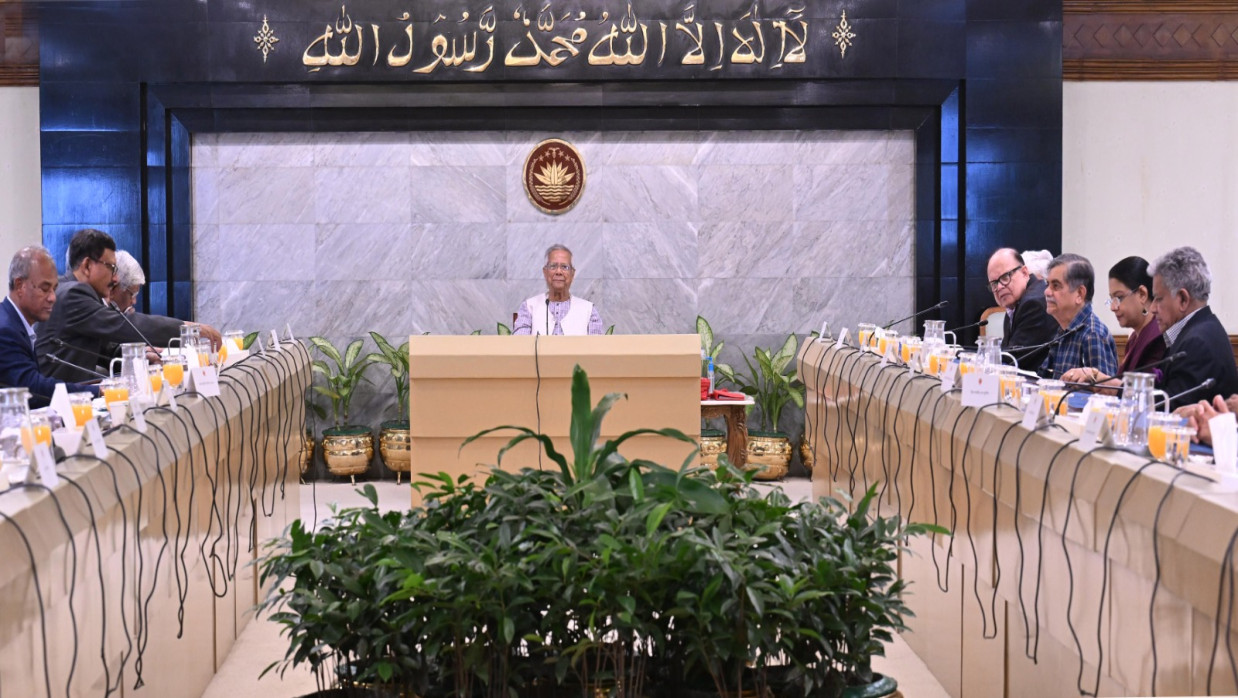
Dr Shahdeen Malik recently described Bangladesh’s interim government’s performance as “somewhere between a second division and a third division.” This was not a passing grade. It was, instead, a carefully-worded indictment, one that struck across law, governance, policing, the judiciary, and election uncertainty. Last weekend, Dr Malik sat down with Prothom Alo editors to share his candid thoughts on Bangladesh’s transitional government. Here are some takeaways:
Grading the Interim Government
First: the grades.
Asked about the Interim government’s performance as a whole, Dr Malik hedged his bets slightly but suggested that somewhere between B and C would be a fair assessment. Positives included the appointment of judges. Negatives: “dishonestly wresting away” a large number of judges from their positions; the Interim government has created fear among police officers and judges. Courts seem unwilling to take cases at the High Court and SC level. The mindset among law enforcers that is arrests followed by extortion hasn’t changed either.
It’s a damning review of institutions Bangladesh still depends on. Judges appointed. Judges removed. Confidence in the judiciary was shattered. Police fears exist. Law-enforcers stick to “old habits”: arrest, make money, go home. More bail, more jobs for the lawyers. Everyone in the law enforcement media is making money as usual.
And absent from this review: teachers forced to submit “character certificates” to appease political authorities, who now teach without heart. Civil servants brow-beaten and terrorized into submission, now carry out orders without questioning.
Systemic uncertainty, Dr. Malik seems to say, plagues Bangladesh’s Interim government.
The Referendum: Legality vs Legitimacy?
Asked about the planned referendum on constitutional reform, Dr Malik called it “legally very confusing.” He warned that the referendum could violate Article 142 of Bangladesh’s constitution. Constitutional adviser Ali Riaz disagrees. In an interview with Zillur Rahman of Trityo Matra, Riaz said democracy can’t function without elections, meaning the Interim government must oversee them.
As for referendums? They’re not unconstitutional, says Riaz, if citizens want them. To Dr Malik’s way of thinking, holding a referendum before elections is like trying to put a square peg in a round hole: legally incoherent and therefore foolish. To Riaz, legality lags behind legitimacy. Even if elections aren’t strictly Constitutional, they are necessary. As for referendums, they may well be constitutional too if the people desire it.
Herein lies the crux of the debate.
For Dr Malik, transitional Bangladesh must attempt to restore constitutional normalcy. For Riaz, restoring normalcy comes after ensuring legitimacy.
Elections: Coming or Cancelled?
Shafiqul Alam, Press Secretary to Chief Adviser Professor Yunus, told Al Jazeera last weekend that Bangladeshis can expect credible elections this year. Others are not so sure. Asked about a referendum debate originally proposed by Dr Malik, BNP leader Amir Khasru dismissed it out of hand: there was no referendum question in 1973, he said, and there doesn’t need to be one today. That doesn’t quell fears that the election itself may not happen.
Journalist Zulkarnain Saer recently returned to Bangladesh after reporting for Al Jazeera. His dispatches from Bangladesh paint a bleak picture: activists thrown in jail for criticizing the government. It’s hard to have faith in elections if you fear criticizing the government planning them.
The Question of Confidence
Between conflicting statements from government officials, recoiled judgments from legal experts like Dr Malik, and reason to doubt our rule of law can function independently of political will… who can have faith that elections will occur on time?
Here’s one answer: Bangladeshis.
Public opinion, for what it's worth, suggests Bangladeshis have complete faith that elections will be held. That may be naive. But it also suggests how far our leaders have left to go. Fair elections require faith that ballots cast will be counted. They also require faith that criticizing the process will not land you in jail.
Until Bangladesh can build confidence, talk of elections will be just that: talk.


0 Comments
LEAVE A COMMENT
Your email address will not be published