

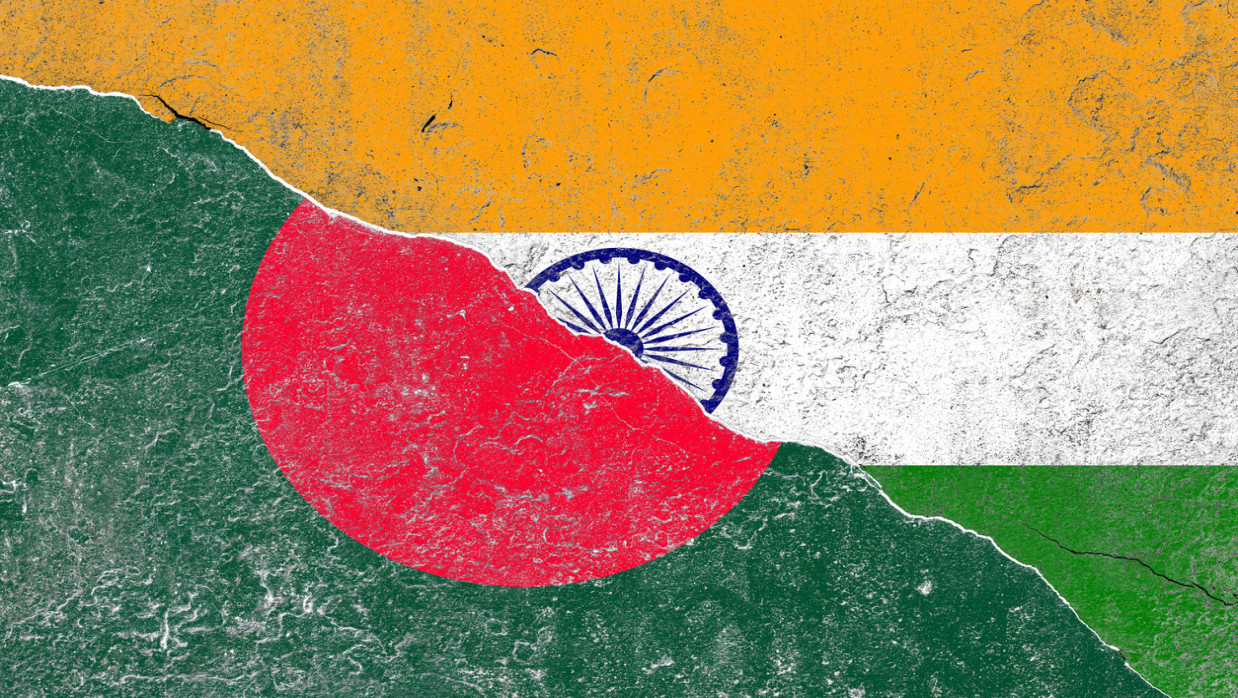
The Backdrop
On November 17, the former Prime Minister of Bangladesh Sheikh Hasina, was sentenced to death in absentia for crimes against humanity for her active role in ordering a brutal crackdown on the student uprising of 2024. In early 2025, the United Nations Human Rights Office found that Sheikh Hasina’s Awami League party systematically engaged in a series of human rights violations during the student-led protests which toppled her government and led to the deaths of at least 1400 people.
Sheikh Hasina remains in exile in India after having fled Bangladesh on August 5, 2024. The interim government of Bangladesh, led by Chief Advisor Professor Muhammad Yunus has repeatedly requested India for her extradition, citing the 2013 bilateral extradition treaty between Bangladesh and India. Repeated requests have been made for Hasina’s extradition, to which India remains largely silent. This leads to Bangladesh perceiving India’s sheltering of Hasina as “unfriendly” and it has even considered approaching the International Criminal Court (ICC) if necessary.
India’s Response
India’s response has essentially been very measured. The Ministry of External Affairs has stated that it is “examining” the matter via judicial processes, while simultaneously affirming its commitment to the stability and democracy of Bangladesh. This type of generic responses by India and avoidance to heed extradition requests indicate that India may not extradite her. There are several factors to consider in this regard:
*There are provisions in the extradition treaty and India’s Extradition Act of 1962 permitting refusal if the offense is considered to be political, in bad faith or in the interests of justice.
*There are very profound ties between India, Sheikh Hasina and her party, the Awami League.
*There is a political consensus in India against the extradition particularly in relation to the death sentence and concerns over the fairness of the trial, which was conducted in absentia, drawing criticism from international human rights organizations such as Amnesty International.
Points To Note With Regards To India’s Position
It must be noted that the glaring hypocrisy in India’s position is hard to miss.
First, for a country which plays the “internal affairs” card for any internationally evident overreach, such as its human rights violations against minorities, India sees no problem in interfering in the political and judicial process in Bangladesh.It is evident that a request for extradition will be based on political issues. Hence, India’s Extradition Act’s refusal to extradite Hasina based on a political offense is duplicitous.
Second, citing that the death sentence was pronounced in absentia is yet another dishonest factor. It is India which refused time and again to ignore extradition requests. Hence, citing the absentia factor is hypocritical, to say the least. Can Bangladesh And India Overcome Their Political Differences, Clear The Slate And Improve Relations?
The one point which is absolutely clear with regards to Bangladesh's position is the distrust which has fostered towards its neighbor, with the latter’s absolute bias and favoritism towards Hasina and her regime, perceived in Bangladesh to be authoritarian, corrupt and completely devoid of any regard for human rights.
Clearly, bilateral relations between the two countries hit rock bottom in 2024 and beyond. Significant points of contention were India’s perceived violations of minority rights (particularly those of Hindus) in Bangladesh. However, factors of civil unrest are often credited to India’s intelligence agency RAW’s false flag operations to create instability within its neighbors. Interestingly enough, India’s own grave human rights violations of minorities, particularly of Muslims, seems to be of no concern and one deemed by India as its “internal matter.”
Another very noteworthy point of contention is the “shoot on sight” policy which India has along its border with Bangladesh, a policy by which countless Bangladeshi civilians are targeted recklessly. Under the leadership of the interim government, Bangladesh has developed friendlier diplomatic ties to China and Pakistan and weaned itself off of India’s hegemonic grip which was willingly established by the Hasina regime. Despite these challenges and difficulties, both sides have maintained a measured and pragmatic approach to bilateral relations in the post-Hasina era.
In this regard, there have been high level meetings between the two countries. Bangladesh’s foreign policy stance towards India places an emphasis on the fact that the Sheikh Hasina issue will not obstruct friendly diplomatic ties and cooperation. There are a number of elements of mutual interest such as trade, security, water sharing (such as the Teesta River unresolved dispute) and a mutual desire for regional stability.
Moving Forward
No matter how many efforts there are to maintain amicable diplomatic and economic ties between the two nations, the Sheikh Hasina factor remains a thorn in the ties, despite all the diplomatic jargon of maintaining a status quo. India’s continued refusal to extradite Sheikh Hasina will most definitely be seen as an interference in Bangladesh's internal matters, with larger implications on trade, water sharing and security.
Neither side wants an escalation. However, for the people of Bangladesh, Sheikh Hasina and her party’s extensive human rights violations which amounted to extrajudicial killings, enforced disappearances, torture, a total ban on the freedom of speech and surrendering of sovereignty to India, the matter is less nuanced. Sheikh Hasina was convicted to death for her role in the 2024 crackdown, but the country clearly remembers almost two decades of a complete authoritarian rule and plundering of its resources.
In spite of efforts on the part of the current and future administrations to maintain stable ties with India, the sentiment of the people of Bangladesh will remain distrustful towards its larger neighbor. India’s role is currently perceived as that of the hindrance to Bangladeshis receiving justice. In order to maintain a relationship with the people of Bangladesh long term , this should be a matter of concern.

0 Comments
LEAVE A COMMENT
Your email address will not be published