

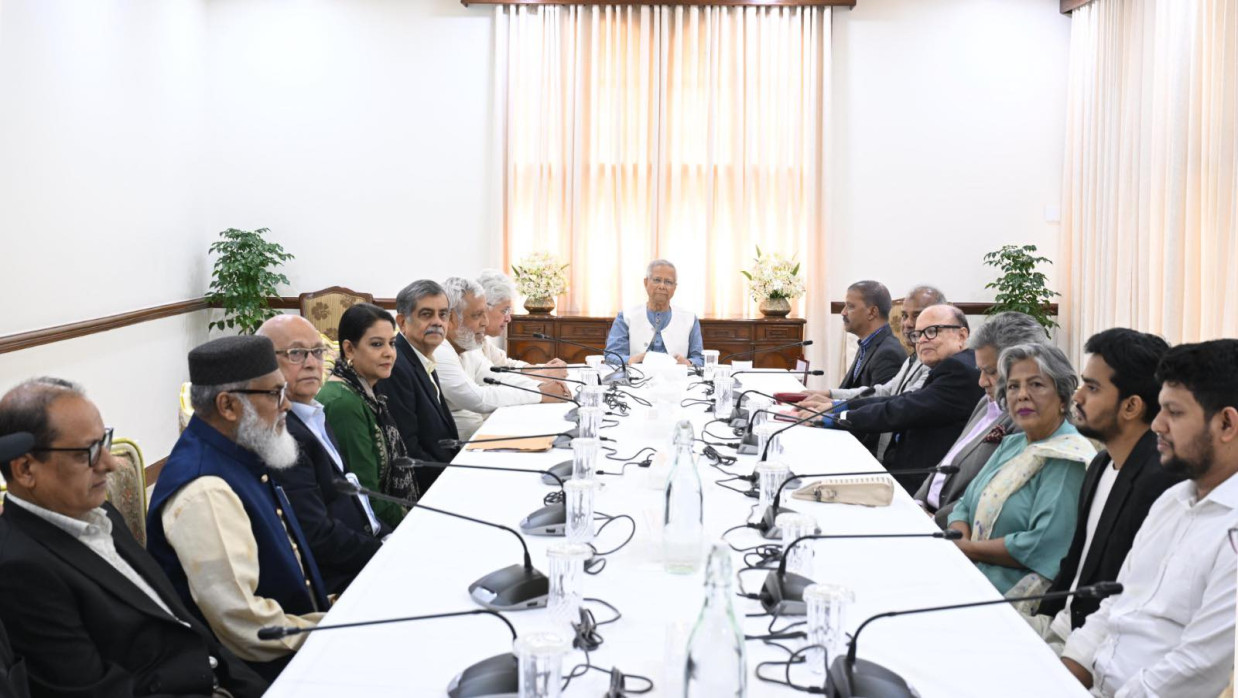
Rarely has any government in Bangladesh’s fractious political life been so roundly condemned so early, and so much done in so little time as this interim government of Professor Muhammad Yunus. Condemned by its critics since day one as illegitimate, accidental, temporary, and weak, many even ridicule it as an NGO-style CTG with little enforcement power, no mandate from any election, and little influence over the well-oiled machinery that constitutes the state's bureaucracy and coercive apparatus. And yet, when the din and clamor of politics dies down, and historians come to pass judgment on it with the clarity of hindsight and distance, it is not entirely inconceivable that the transitional government may go down as one of the most essential such governments that Bangladesh has had in recent decades, if not the past few generations.
Look, for instance, at some of the things that have been said about it: we have seen “concerned” citizens complain about the interim government’s inability to control the streets when people are protesting; others, that the government doesn’t have the heft with which to conduct serious diplomacy, and the major powers of the world are “hedging” their bets with Dhaka, unwilling to have their high offices meet the CTG’s leadership; and at home, a refrain that it’s all “talk and no action,” that the administration is too “accommodative” with the pressure groups, that it lacks the “political will” to crack the whip on those that need to be “handled” or “taught a lesson”. In short, this is how many in the political world perceived the interim government: all bark and no bite, this administration lacks the backbone of the country that Bangladesh has become after almost two decades of Islamist-authoritarian consolidation.
And yet, results speak for themselves.
A Revolution Without a Revenge
At its simplest, consider what Bangladesh would have looked like if the culture of impunity unleashed by decades of authoritarianism, and intensified manifold by the last government and its years in power, had not been checked at all during this interim period. Retaliatory violence against perceived or real wrongs would be the order of the day, with even the capital at peace being no longer guaranteed. There would have been scores to settle, vendettas to be unleashed, mob justice, “crossfire” killings, politicized violence, and looting of every kind. Bangladesh has not been entirely free of these things, but, comparatively, it has been spared the worst. The incidents of politically-linked targeted killing are near zero during this period (and from what we understand, mainly through the disbursement of surreptitious death threats), the ghost of enforced disappearances has been well and truly laid to rest, and staged “crossfire” killings that have been defended for so long as necessities of law enforcement are no longer reported. There is no explanation for this phenomenon more palatable than this: a government that had neither the mandate to carry out revenge killings nor any electoral legitimacy had decided to set an example of restraint and adopted the approach that it would not replace the culture of impunity with a culture of revenge. That, right there, is a civilizational leap in the culture of governance.
Judicial Rebalancing
The most institutional, systemically impactful, and durable legacy, however, would have been this: a Supreme Court much more independent, empowered, and effective. The interim government’s move to shift more oversight powers over the subordinate courts from the executive (meaning the government) to the judiciary has had the effect of curbing a long-standing practice, and that is the executive’s ability to weaponize bail, remand, and lengthy pretrial detention of anyone and everyone that it wants to “punish” without due process. We still do not know what justice will look like in Bangladesh, but one of the worst means of selective executive or political revenge has been significantly attenuated. This is not, by any means, a panacea that can ensure anything resembling just outcomes, but it is a welcome rebalancing of powers and authority.
Running alongside this is the simple fact that accountability processes, even if slow, inordinately long-drawn-out, and by no means complete, have formally begun. Whether one or two dozen cases have concluded, the delays in sentencing, or the lack of it, in prominent cases can be mulled over and critiqued at length. Still, for a system that was manifestly allergic to even a partial measure of accountability, this, by itself, is a step. Some may call it a small step, but it was the first one, and that is where it should be marked.
Systemic Cleansing and Economic Stabilization
It would also be foolhardy to underestimate what the interim government has inherited when it comes to the economy: a financial sector whose banks have been bled white by political and family patronage networks that operate on networks of insider lending, interest-free or “gift” default, and debt write-offs; a depleted and regulated banking sector that lost public trust years ago; inflation in the high single digits that have translated to loss of purchasing power for the common man; and a severely dented investor confidence that came on the back of political crisis and a general mismanagement of the economy since the last elections. It is a miracle, to be sure, that the interim government has reversed all of the above trends over a year in time: from inflation, especially food inflation which now stands well below where it was when the government came in, to exchange-rate stability, and, most importantly, the systemic looting of banks and financial institutions, which has come to a halt. Even the monitoring and regulation, and thus the enforcement to prevent such practices from resurfacing, has been greatly improved. This was stabilization. This was not a “radical” change. But stabilization is precisely what the country needed.
Investment and Signaling
It would also be, frankly, unfair to point out the near-complete turnaround in the Europeans coming to an agreement with the Bangladesh government and signing a lease agreement for a container terminal with a European entity for infrastructure investment. For a country that is, in the coming decades, highly likely to see GDP growth closely tied with the ports and its capacity to keep pace with surging trade, to land an infrastructure investment of this kind, which will not only help with the nation’s bottom line but would allow it to diversify away from overdependence on Chinese foreign direct investment (FDI) is something to be duly noted. The agreement also signals something else: that Bangladesh, even under an interim government, is capable of engaging, reaching consensus on long-term visions of industrial development, and even in logistics and trade facilitation. This will not have escaped the prominent economic actors with an interest in Bangladesh, including the domestic ones, and they, along with future elected governments, will inherit this and build on it.
Similar attention must be paid to the foreign policy repositioning Bangladesh has undertaken during this period to reassert itself as a country firmly rooted in the Indo-Pacific region, yet not militarily aligned with any regional bloc, nor explicitly hedging its bets against any other. It is an active rebalancing that is no longer overly dependent on an “alliance” with just one significant power or the other. It is declaratory, yes, but it restores to Bangladesh the diplomatic space it needed in the years after Sheikh Hasina cast Bangladesh in a far too limited geopolitical box.
A Country Begins to Speak
Last but not least is the basic restoration of civil and expressive liberties that this transitional period has allowed. It is the palpable sense that Bangladeshis have of being able to speak their mind, to be able to write without fear of being monitored, without fear of arrest, intimidation, and harassment that has returned in all aspects of public and intellectual life. From the mainstream media outlets that have rebounded in confidence to the intrepid few in online and alternative media, all the way down to ordinary Bangladeshis being able to engage with their society on terms that don’t require permission, are again free to use their civic spaces, express themselves, and create what they want, without all of the above. We have already seen this in the quantity and quality of documentaries and non-fiction works produced on essential subjects. Bangladesh has begun to speak and its voice, whether it is the movies, literature, satire, polemics, or even music, is no longer in self-censorship mode. That will, in time, be one of the more durable things about this era.
What is Missing?
None of the above is to say that the interim government was perfect, or that its record was complete or done. In fact, it is to this author’s mind one of the principal deficits of this government that it was sometimes seen to be too conciliatory to specific political interests in the name of “consensus”; factions, in fact, who were demonstrably and visibly quite loyal to the forces associated with the ancien régime and, more damagingly, to outside actors who not-so-secretly backed those forces to the hilt. That this is a signal of some of the government’s own political reservations is highlighted by the fact that, in particular, the Ministries of Home and Foreign Affairs were often markedly more tentative than was required by the moment. The appointment of several somewhat questionable advisers and the retention of some more controversial ones at key junctures in time did little to help the government project confidence, either. If we are to believe reports in the media, this same caution also allowed, at least, an implicit license to some influential institutional players to get away with murder, so to speak, and this said a lot about either the unwillingness or inability of the government to act on them. By far the most worrying, or perhaps the most dangerous lacuna, is the sequencing issue. The government kept assuring us of the roadmap, but in fact promised to begin by delivering justice, then move on to reforms, and then hold elections. The latter is now, under domestic and international pressure, coming much, much sooner than the former two were to have been completed, if at all. The last several decades have shown us time and again that this is dangerous. Holding elections atop an unfinished transition that leaves judicial and political accountability incomplete at best, and farcical at worst, recreates the old power structures in new names. If that happens, all of the above would be a farce in a macabre theatre of absurdities.
Unfinished Business
A related challenge about the July Charter is that, in many parts, we have heard it is factually and ideologically skewed, as if to reopen old questions rather than settle them. As we understand, some of these ideological disputes were debated at length before the draft came to be in its current form. Transitional documents, like a charter or even a constitution, are not meant to reopen history. They are intended to move society forward to an understanding of the future. A society cannot look forward if it is forever looking backward. The charter needs to be clearer and final.
The Right Distance
Bangladeshis will often point back in their nation’s modern history to another such transitional government, that of Ziaur Rahman, where an overwhelming display of public sentiment and will enabled, in a short time and in the face of manifold resistance, transformative governance. It would not be accurate or fair to say that this interim government has achieved such sweeping results; nor would it be fair to say that this is an insignificant interim government with little impact. However, when judged against the imbalances that it faced by the sheer absence of an electoral mandate, the rot within institutions that it inherited, and the criticism that it was regularly greeted with at every juncture, it may yet stand up as a transitional period that was far more effective and useful than its critics care to remember.
The Final Test
But the final test of any transitional government will not be the verdict of history, or even the next administration, but whether it lasts. That is, whether the changes it has either put in place or allowed other actors to make are not reversed. If judicial independence persists, if enforced disappearances no longer haunt the country, if banks once again become private institutions for the few and not political spoils of the victorious in the forthcoming elections, and if the freedom to speak, to publish, and to form or join an association without being harassed, hounded, or hunted remains. This transitional phase may well be remembered not as a lull between elections or governments, but as an inflection point.
Few such transitions are ever graceful or complete, of course, that is their nature. But Bangladesh’s seventh interim government has shown that even the one widely derided as a weak one can, if it chooses restraint, principle, and selective bravery, move a country in a new direction. That, in quiet, may be its lasting legacy.


0 Comments
LEAVE A COMMENT
Your email address will not be published