

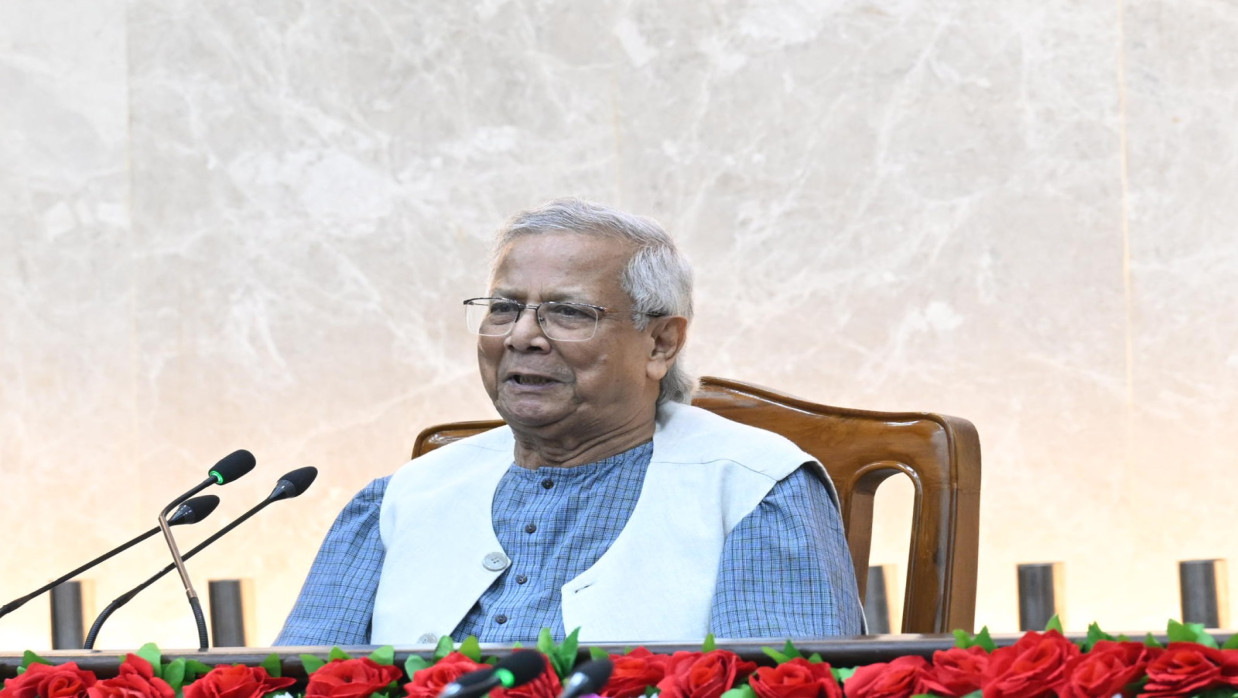
Following Sheikh Hasina's removal from the position of Prime Minister of Bangladesh, Muhammad Yunus assumed leadership of a non-partisan interim government. His strategy for political survival involved forming alliances with Islamist parties and cultivating strong connections with global neo-liberal forces. A notable early sign of the interim government’s inclination to accommodate religious fundamentalist elements was its decision to lift the ban on the controversial right-wing Jamaat-e-Islami Bangladesh (JIB).
Simultaneously, the administration adopted a neoliberal economic agenda aligned with the International Monetary Fund’s (IMF) recommendations. By systematically marginalizing left and centre-left political parties and activists, the Yunus government appears to be steering toward the establishment of an ultra-right regime characterised by social and economic conservatism.
The Yunus administration’s accommodation of Islamist fundamentalism extends beyond the legitimization of the Jamaat-e-Islami Bangladesh (JIB). The party has become a key player in the interim government’s decision-making process, positioning itself as a significant stakeholder in the reform commissions initiated by the government. JIB has also taken the lead alongside other extreme right-wing groups, such as Hefazat-e-Islam, Islami Andolan Bangladesh, and Khelafat Majlis. These groups have not only increased their strength and legitimacy but have also actively supported Yunus's reform agenda in exchange for concessions concerning cultural and educational policies. As a result, the interim government has yielded to their demands, which included the removal of music and physical education instructors in primary schools and a tolerance for demands aligned with Islamist ideologies, such as restrictions on women’s rights. This evolving alliance has significantly transformed the political landscape of Bangladesh.
Islamist leaders have leveraged their influence to promote ideological shifts, including calls to dilute secular principles within constitutional reforms, while mobilising mass demonstrations to assert their power. There have been numerous violent attacks on media outlets, including the most prominent Bengali and English daily newspapers, a leading music school, and progressive and secular cultural institutions such as Udichi, a respected left-leaning cultural organisation. Over the past 17 months, approximately 2,500 attacks have been reported against minority religious, ethnic, and sectarian communities, reflecting a clear agenda to radicalise society and promote a regressive social order. In one particularly tragic incident, a young Hindu man was beaten to death by an extremist mob, and his body was hanged from a tree and set ablaze. Critics argue that this development undermines the secular foundations of Bangladesh and increases societal polarisation, as Yunus’s reliance on Islamist legitimacy compromises his tenure in office for the sake of long-term ideological shifts in the nation.
The current economic situation in Bangladesh is highly precarious. The interim government has implemented measures to tighten fiscal and monetary policies to control inflation and restore the external balance. The process of rebuilding reserves has commenced following recent exchange rate reforms. However, little success has been achieved in both areas. Persistent issues, such as weak tax collection and a capital shortage in the banking sector, continue to pose significant risks to the country. The proposed banking sector reforms, as recommended by the International Monetary Fund (IMF), are likely to further hinder economic growth. Inflation has surged to nearly 9 percent, with the food inflation reaching around 14 percent. Non-performing loans (NPLs) increased from BDT 3.45 trillion in December 2024 to BDT 4.2 trillion by March 2025. As a result, the NPL ratio is above 24 percent, far exceeding the global distress benchmark of 10 percent. Additionally, there is widespread industrial turmoil, exacerbated by factory closures, rising unemployment, and a chaotic capital market, all contributing to a notable increase in the number of people living below the poverty line.
Critics from a socialist perspective contend that the efforts of Muhammad Yunus’s interim government to implement an IMF-prescribed policy framework signify a shift towards neo-liberal restructuring. Bangladesh, like many developing countries, often relies on international institutions such as the IMF and World Bank. Previously, toward the end of the Hasina administration, an IMF loan was approved to stabilise the economy and safeguard the foreign currency reserves, which had been severely impacted by the global economic crises following COVID-19 and the Russia-Ukraine conflict. The Hasina government had garnered praise for driving economic growth primarily through a developmental state model and domestic policy leadership, rather than relying on externally imposed reforms.
Although they had to recalibrate their policy at the end, Muhammad Yunus’s interim government made a more radical move. Yunus’s regime, which received support from organisations like the IMF and World Bank, made a significant pivot by adhering to their prescribed framework. As local businesses grapple with escalating energy costs and infrastructural challenges, the Yunus administration continues to focus on reform rhetoric and purported foreign investment. Regressive policies underpin the reform agenda, and the additional foreign investment secured during this period was primarily attributable to intra-company fund transfers, driven by high borrowing costs and exchange-rate volatility.
Over a span of 17 months in office (up to December 2025), Mr. Yunus travelled to 14 different countries, while scarcely visiting any district or divisional cities in Bangladesh. This further demonstrates his persistent efforts to appease international neoliberal forces rather than to engage with the wider population in Bangladesh. He has assembled a cronyistic advisory council of elitists who appear to have a closer alignment with Western capitalism than with the lived experiences of ordinary Bangladeshi citizens. Moreover, the recent agreement with APM Terminals, a subsidiary of the Maersk Group, to develop and operate new terminals at Chittagong Port raises questions about transparency. As a result, despite the Yunus regime’s assertions of economic recovery and ambitious greenfield projects, the reality is bleak. Rising inflation, currency depreciation, and a decline in institutional credibility have contributed to low public confidence and increased risk.
Economists warn that the government’s ‘ill-timed policies’, which include contractionary monetary measures and sudden tax hikes in an environment marked by low local investment and deteriorating law and order, have stunted growth, which currently lags below 4 percent, a significant decline compared with the past 17 years. Rather than promoting stability, the Yunus era has exposed the vulnerabilities of Bangladesh’s economic foundations, placing the nation perilously close to an economic crisis.
The Yunus administration, navigating a complex landscape of right-wing religious fundamentalists, local and international neo-liberal operatives, and a power-driven military establishment, seems to be exploiting the judiciary to undermine democratic left and centre-left political forces. With over 400,000 political activists imprisoned and 200 individuals killed by mobs (mostly right-wing activists and Madrasa students) only in 2025, echoes of the Jakarta Method are evident. This situation reflects a sustained effort to stifle progressive and centre-left politics in Bangladesh while establishing a tyranny of extremist religious indoctrination, which serves as a façade for economic exploitation.
It is essential for progressive and democratic individuals and institutions worldwide to condemn the Yunus administration and call out its regressive, authoritarian, and exploitative actions. Muhammad Yunus, a Nobel Laureate, garners acclaim from global civil society. However, it is important to remember that his counterpart in Myanmar, Aung San Suu Kyi, has been subject to criticism for her alleged involvement in ethnic cleansing and human rights violations against the Rohingya Muslims. Therefore, a Nobel Peace Prize does not confer immunity or a clean slate; Muhammad Yunus should not be seen as an exception. As Bangladesh approaches its general election, it is crucial to scrutinise the credibility of any election conducted under the oversight of such a questionable administration.


0 Comments
LEAVE A COMMENT
Your email address will not be published