

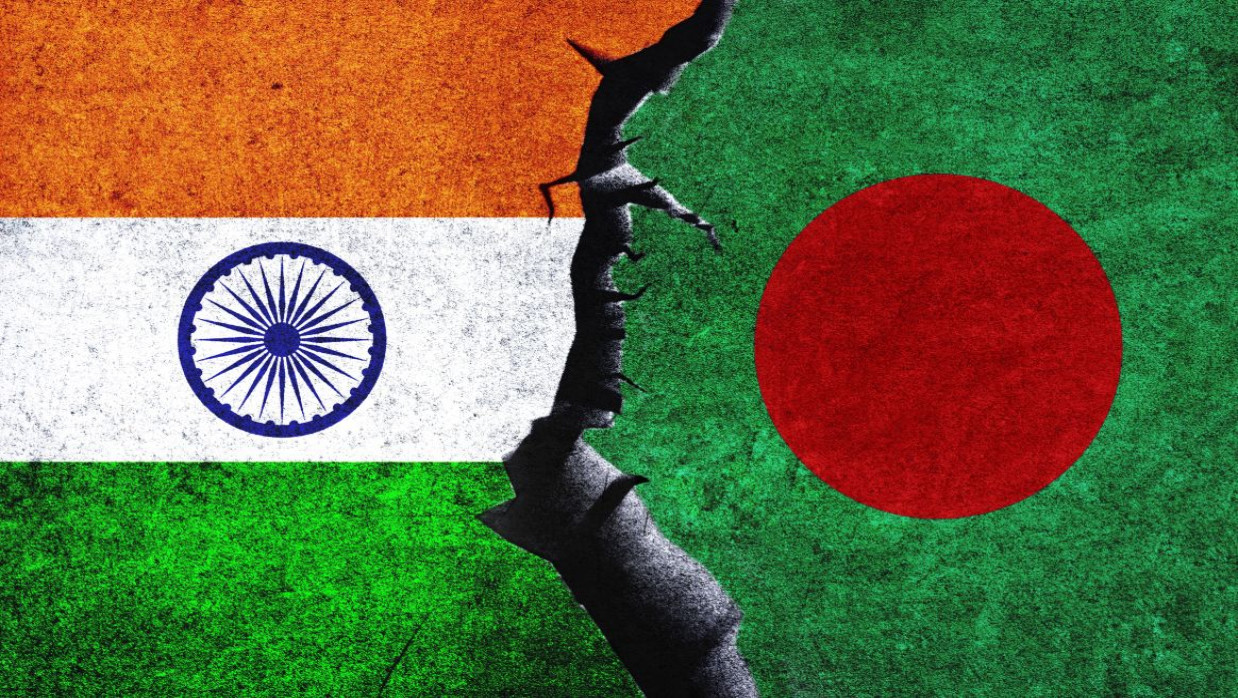
When the deposed Bangladesh Prime Minister Sheikh Hasina fled Dhaka by military helicopter on August 5, 2004, there was little doubt about where she was heading for – where else but India. Indeed, in the face of a mass uprising and to avoid its predictable consequences, lynching, her fleeing to and taking shelter in India hardly came as a surprise. After all, one of her foreign ministers once described the relation between India and Bangladesh like “husband and wife.”
The day after, August 6, 2025, Sheikh Hasina fled to India the Telegraph of India aptly headlined the news saying, “Hasina Falls, Lands in India”.
While Hasina’s fall marked the end of her 15 year-long despotic and kleptocratic rule which was greeted with great enthusiasm and jubilation across Bangladesh, in New Delhi Hasina’s fall was regarded as a pure disaster and her landing in India created a diplomatic crisis for the Modi government – they are in a fix not knowing what to do with their deposed VIP guest, Hasina Ji.
India’s self-inflicted diplomatic predicaments
Indeed, Hasina’s ouster is a major diplomatic blow to India for under the Hindu supremacist Prime Minister, Narendra Modi who effectively staked India’s one-sided profiteering relationship with Bangladesh on Hasina’s despotic regime is suddenly dislodged, leaving a huge void in the bilateral relationships between the two neighbours.
Indeed, as far as India/Bangladesh relationships are concerned, Modi is no exception. This was also the foreign policy position of the opposition party Indian National Congress about Bangladesh though not as blatantly and as one-sided as Modi’s.
Congress leaders Rahul Gandhi and his mother Sonia Gandhi, both members of the Nehru dynasty maintained very close personal ties with Hasina.
In other words, and given the turn of events in India’s relationship with Bangladesh that hinged historically on one individual and on one party and not on people, has turned into a nightmare for the Indian government and the problem got compounded as Bangladesh’s post-Hasina Interim Government led by the Nobel Laureate Professor Muhammad Yunus has sent a formal request to the Indian government to extradite Shiekh Hasina soon after the Bangladesh’s International Crimes Tribunal (ICT), a court constituted by Hasina herself in 2009, sentenced the deposed Prime Minister and her self-exiled (to India) home minister Asaduzzaman Khan to death, finding them guilty of crimes against humanity.
Then on November 27, 2025, a court found Hasina guilty of illegally securing plots of public land in a suburb of the capital, Dhaka, for herself and her family members despite their ineligibility and sentenced her to 21 years imprisonment and her son and daughter each got 5 years jail sentences each where the presiding judge observed, that the deposed prime minister of Bangladesh “demonstrates a persistent corruption mindset rooted in entitlement, unchecked power, and a greedy eye for public property.”
Anti-corruption authorities in Bangladesh also have seized about ten kilograms of gold worth about $1.3 million from bank lockers belonging to Hasina, on November 26. Investigators also said Hasina had failed to deposit some of the gifts she received while in office at the state treasury, known as "Toshakhana", as required by law.
Sheikh Hasina’s death sentence will remain unenforceable so long she is in India. Therefore, for the sake of delivery of justice, she and her minister’s extradition back to Bangladesh is not just essential but a legal requirement. However, because of India’s decades long close ties with the Awami League and Hasina’s family which go back to her father’s time, there is little support in India for her extradition to Bangladesh.
In a letter dated November 21, 2025, the Bangladesh foreign ministry had stated that New Delhi is obligated under the 2013 extradition treaty to transfer Sheikh Hasina to Bangladeshi authorities. The ministry further stated that keeping Hasina in India constitutes a serious act of unfriendly behaviour, describing it as "a travesty of justice for any country to grant asylum to individuals convicted of crimes against humanity."
After the verdict was announced, the Indian Ministry of External Affairs said in an official statement that, “India has noted the verdict announced by the ‘International Crimes Tribunal of Bangladesh’ concerning former Prime Minister Sheikh Hasina. As a close neighbour, India remains committed to the best interests of the people of Bangladesh, including in peace, democracy, inclusion, and stability in that country.” The statement added, “We will continue constructive engagement with all stakeholders.”
The Indian foreign ministry has only confirmed receiving and reviewing the extradition request, without commenting on its response nor action. A previous request for the extradition of Hasina, dated December 23, 2024, was submitted so that she may face charges of crimes against humanity related to the July 2024 uprising, including multiple murder cases also remained unanswered. Simply put, India simply and consistently ignores Hasina extradition requests of Bangladesh government.
Furthermore, India’s efforts to relocate Hasina outside India did not meet with success either. India soon realized that there are no takers of Hasina outside India, the “largest democracy of the world” because of her repressive authoritarian political past. Her strong connections with influential figures from both within the BJP and the Congress in New Delhi have made her position in the city quite secure. Bangladesh-India relations already strained following Hasina’s ouster last year, is now poised to be frayed even more.
India’s Islamophobic rhetoric, entrenched authoritarianism and suppression of Bangladeshi nationalism in Bangladesh via Sheikh Hasina
India’s preference for Hasina and its relations with Bangladesh was premised until August 5, 2024, on Islamophobic rhetoric which is that Bangladesh is the hotbed of Islamist terrorists and extremists and only Hasina and Hasina alone could keep them under control to keep “Mother India” safe.
Under the Modi government Islamophobia has been turned into a foreign policy tool deployed against Muslims and more importantly against anti-Hasina sentiment in Bangladesh that in turn also helped Hasina to maintain her grip on power with impunity and India its opportunistic, economic and geopolitical, hold on Bangladesh.
The intensity of Islamophobia unleashed in Bangladesh by the Hasina regime backed by India was phenomenal resulting in targeted killings, abductions, forced disappearances and imprisonment of thousands of Bangladeshis.
Saffron Flag and rise of a sectarian bullying India
India is a country where 84 percent of population are Hindu and 14 percent (appx.) are Muslim. Modi and his Hindu supremacist party BJP must have achieved an astonishing feat of success in creating a fear of threat coming from Indian Muslims, i.e. creating Islamophobia within India. This is deeply worrying not only for the people around the world but also for vast majority of Indians who are opposed to bigotry.
Mr. Modi is more vigorous in hoisting saffron flags, digging under mosques, and changing city and road names bearing Muslim names rather than spending money on improving public hygiene with which India has a serious problem, and investing in education, and health care.
Hasina was entirely depended on India in conducting three rigged elections between 2014 and 2024. In this venture both the BJP and the Congress were full partners. Her regime survived because of this bipartisan support. Hasina’s close personal ties with both the BJP and the Congress parties in New Delhi helped Bangladesh become India’s closest and most loyal regional ally or more precisely a client state. She herself said that India would forever remember what she had done for India.
During an interview with Karan Thapar for The Wire, historian, author, and political commentator Ramachandra Guha noted that the Modi government has shifted from calling India a Vishwaguru (teacher of the universe) to referring to it as a Vishwamitra (friend of the world). However, Guha argues that the people in the neighbouring countries such as Bangladesh, Maldives, Nepal, and Sri Lanka, do not regard India a Vishwamitra, but a Big Bully. Guha also points out that each of these countries has experienced numerous instances of political interventions by as well as rhetorical boastfulness of India.
Guha’s perspective becomes clearer when considering claims like ancient India possessing Star Trek-level technology. These Indian inventions are limited by human fictional imaginations. India also has a massive problem with cultural narcissism. India as a successor state to the British colonial India still grappling with identifying with the Mythical India. Even Nehru could not distinguish between the two.
India’s relationship with the Hasina regime over the last 15 years is a telling example of that. He further points out that the Vishwamitra policy will not work with countries like Pakistan and China where the state itself is hostile to India. Guha points out that India’s Big Bully attitude to its neighbours did not start with the Modi government. It stretches back all the way to Jawaharlal Nehru. In this context it is important to note that the vision of India as outlined in Nehru’s book The Discovery of India is described as “an elegant combination of history and propaganda” by Patrick French, a British writer, historian, and academician.
But now the Hindu supremacist party BJP’s Hindutva offers a much more aggressive vision of India than what was envisioned by Nehru in his book. So much so that Stanford University Anthropologist Thomas Blom Hansen described the Hindu supremacist Modi government as a “Regime of Low Intensity Terror.”
Anti-Bangladesh conspiracies on Indian soil
Many AL leaders who were very close to Hasia, followed her and fled to India, are based in Calcutta including her home minister Asaduzzaman Khan who has also been sentenced to death along with her. They are using social media platforms backed by what is in India described as “Godi” media termed the verdict a political “conspiracy” orchestrated by the Muhammad Yunus-led interim government to bar the party and Hasina from contesting the upcoming general elections scheduled for February next year. Rejecting the judgment as the “illegal verdict of an illegal ICT tribunal,” the party demanded the resignation of Yunus. What is more alarming some of these AL leaders also threatening to use violence to dislodge the Yunus government.
They also said that grassroots organisers, political allies, and civil society supporters were being mobilised to resist what it labelled “anti-state conspiracies,” vowing to prevent “any attempt to exclude pro-liberation forces” from the electoral process. But to date, no public demonstration against her verdict could be seen in anywhere in Bangladesh.
The AL leadership based in India is now indulging in historical revisionism to fit its current situation, while failing to learn the lessons from history. Their lack of historical perspective did not make them realise that exercise of naked power has an expiry date. Hasina and dictators before her like Reza Pahlavi, Marcos, Duvalier, Ceausescu, Mengistu, Pinochet, Ben Ali et al eventually found out they all had a limited shelf life.
The smearing campaign against the Yunus government has been relentless —but something more is happening as well; they are also vocal to flirt with their revisionist narratives of Hasina’s criminal syndicate speaking favourably of Hasina’s authoritarian rule. People should keep in mind what the Awami League truly was, and the destruction and death it unleashed, and of the loot and plunder that emptied the national exchequer.
Time is ripe for the people of Bangladesh to unite and confront revisionist attacks against the sovereignty and dignity of people of Bangladesh.
People of Bangladesh must be informed objectively and truthfully what Hasina’s criminal syndicate did to the country, how she rose to power, and the damages she inflicted on the economy of the country and of her flagrant human rights abuses, and the very reasons for which and how freedom-loving Bangladeshis defeated her and dismantled her criminal syndicate and her rule and ensure that such tyrannical rule never returns to Bangladesh in future.


0 Comments
LEAVE A COMMENT
Your email address will not be published