

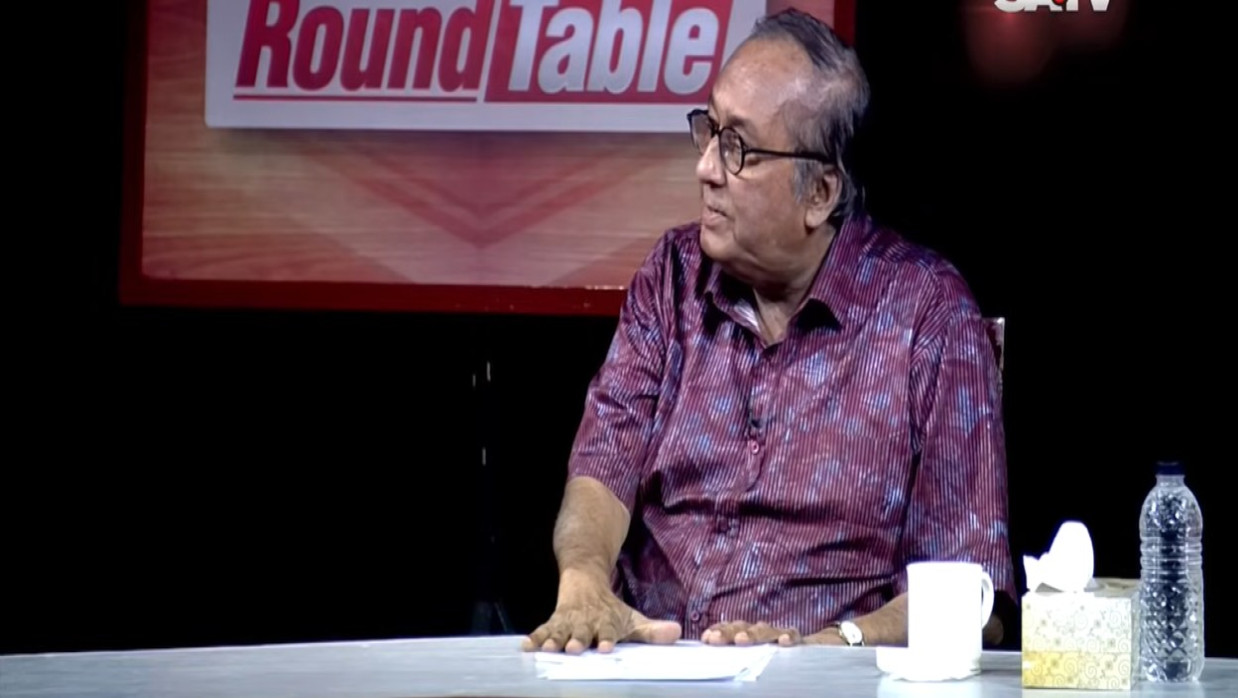
Bangladesh's politics has yet again been thrown into chaos by a seismic claim. In a recent YouTube address, Professor Dr. Shahiduzzaman declared that there has been a political “pact” between the Bangladesh Army and Jamaat-e-Islami. In a country where civil–military relations, 1971 memory politics, and Islamist parties remain among the most sensitive issues, such an accusation was bound to spark a wave of scrutiny, criticism, and condemnation. While one may agree with or dismiss his ultimate conclusion, the overall line of argument he put forward is an important one to debate: what is the nature of power in Bangladesh, and what does the continued weaponization of “independence” as a political label mean for the country’s future?
In this essay, I aim to discuss the central claims and logic Dr. Shahiduzzaman makes and place them in a historical and geopolitical context. In addition, I would like to share my own analysis, which has been shaped by decades of studying Bangladesh’s political economy and interacting with its diaspora communities, on why I believe that the real danger to Bangladesh is not in any putative Army Jamaat arrangement per se, but rather our collective inability to address the deeper structural pathologies of the state itself.
The Allegation and Its Immediate Context
To reiterate, Dr. Shahiduzzaman’s main point is simple, if shocking: sections of the Bangladesh Army and Jamaat-e-Islami have come to a political “understanding”. He presents this not as a rumor or a claim that must be independently verified, but as a logical conclusion that can be drawn from the preceding events and from the alignment of interests. The charge is as explosive as it is because it cuts across two of the Bangladeshi public sphere’s most deeply entrenched narratives and assumptions. On the one hand, there is the army, constitutionally mandated to be above politics and yet deeply implicated in the country’s power struggles; on the other hand, there is Jamaat, which has been primarily portrayed in Awami League (AL) discourse as nothing less than antithetical to the very existence of Bangladesh.
Placing Dr. Shahiduzzaman’s Allegation in Context
The professor anchors his narrative in the last 24 hours of Sheikh Hasina’s rule. In his own timeline, Sheikh Hasina tried to call on India to step in as the protests surrounding the financial institutions’ job quota move were reaching Dhaka. He asserts that she refused to leave Gono Bhaban until outside help arrived, and that India's national security adviser, Ajit Doval, contacted the Bangladesh Army chief, who was on the ground in Dhaka, and recommended that he move her to India. It is one thing to verify each fact and detail of this alleged chronology, which I have not attempted here. It is quite another to question its political import, which is that Bangladesh had reached a crisis point in which its internal sovereignty was inextricably bound up with regional power dynamics.
Independence as a Political Tool
Possibly the most refreshing part of Dr. Shahiduzzaman’s talk is his exposition on how the very concept of “independence” has become monopolized as a sort of moral signifier. In Bangladesh, he argues, for the past five decades the Awami League has rigidly divided the political field into two: those who were “for independence” and those who were “against it”. And while that dichotomy may well have been understandable and even mobilizing in 1971, he argues, it has since become a tool of exclusion.
There are a few polities in the world that go on labeling whole swaths of their citizenry as a-historical, anti-national, solely based on what position they may have taken 54 years ago. And yet, in Bangladesh, this logic has not only become normalized. In the past 15 years, it has become a hugely successful instrument of delegitimization. To oppose the AL was to oppose Bangladesh itself. The political opposition, this logic said, was an enemy within, whose every move had to be foiled. In my own opinion, that narrative strategy exhausted democratic argument and gave cover to authoritarian behavior, all in the name of protecting the legacy of 1971.
Jamaat, 1971, and the 1971 Question
In fact, for many of us, the most controversial part of Dr. Shahiduzzaman’s talk is his revisiting of the one question that can still raise the blood pressure in Bangladesh: was Jamaat-e-Islami anti-independence? In answer to that question, he is both nuanced and unsettling. Jamaat, he says, was not pro-Bangladesh; rather, it was opposed to the break-up of Pakistan. The break-up, in their view, was a tragedy, not because they did not love Bangladesh, but because the creation of Pakistan itself had been an epic sacrifice in 1947. In that sense, he says, to the Jamaat leadership, India’s intervention in the 1971 war had not been for the cause of Bangladeshi nationalism; rather, it had been an act of regional power politics and even, in their paranoia, a threat to Muslim autonomy in South Asia writ significant.
Strategically, tactically, Jamaat, for sure, was not on the side of Bangladesh’s independence in 1971. There was no question about it: they did not support Bangladesh’s independence war with India as an ally. That fact is on the record. What is not, and never has been, was the future of Jamaat-e-Islami or its political vision. In that sense, I must say that I part ways with the professor a bit: I agree that Jamaat’s 1971 position was not one-dimensional; that there were factors that might explain why the party, as an organization, was not on the side of independence. But that does not exculpate them. History also has a statute of limitations, and it is called accountability. A mature democracy allows political space for repentance and rehabilitation based on an honest reckoning of the past, not on historical relativism.
The Awami League’s Own Independence
To underline the double standard and the fundamental dishonesty of weaponizing a single historical moment for political exclusion, the professor goes into the Awami League’s own conduct of the liberation war. And, not to mince words, he uses some pretty hard facts. He reminds the audience of the present AL leader living in Dhaka under the protection of the Pakistani army, having her son born in the military hospital, and getting a monthly allowance from the Pakistanis. His point is not to say that Begum Khaleda Zia was “more independent” than the Jamaat; he is merely showing that the experience of independence was not monolithic, even within the “liberation alliance”. For Dr. Shahiduzzaman, the larger point is one that I am sure will not stop Bangladeshi public debates from raging: a single party and its allies have arrogated to themselves the right to be the sole judges of who was “for independence” and who was “against it”. Independence, for them, has become an exclusive club where the gatekeepers decide who gets in.
Army, Jamaat, and the Deeper Question of Power
Let us return now to the specific charge of a Bangladesh Army Jamaat understanding. My view is that the deeper question is not whether such an understanding exists; it is why such an understanding would have to exist. In other words, what is the nature of power in Bangladesh? In my own lengthy discussions and debates with Bangladeshi civil society, activists, and diaspora groups in the West, I have come to one firm conclusion: there is a deep and widespread sense of frustration, disappointment, and even betrayal with the way in which the AL government in the past 15 years destroyed the idea of democratic pluralism, discredited political parties, hollowed out the electoral process, criminalized dissent, and used national independence as a club to beat its political opponents into silence. When all else fails, it is the familiar game of informal networks and unspoken understandings that makes people speculate on military plans and Islamist compromises, even if the evidence on the ground is not conclusive.
The Moment, Myself, and the Way Forward
As one who has always been an outspoken advocate of strengthening democratic institutions, political pluralism, economic pragmatism, and historical honesty, I view Dr. Shahiduzzaman’s intervention as a provocation, not a conclusion. I take it that way because I believe it forces us to take a long, hard look in the mirror. Yes, we have been robbed of our independence. Yes, our history has been weaponized and mythologized. And yes, our sovereignty has been compromised, not by one party or faction alone but by an entire political culture that has come to conflate loyalty to the country with loyalty to the party.
Bangladesh needs no new pact, imagined or real, between the army and any political party. It requires a new social contract: one of citizenship, not lineage; of accountability, not sloganeering; and of respect for the Constitution, not the whims of individuals. The last days and hours of Sheikh Hasina’s rule, the still-unresolved debates over Jamaat-e-Islami’s political past, and the persistent shadow of Indian and international machinations over Bangladesh’s independence from Pakistan taken together, they all speak to the same conclusion: until Bangladesh rebuilds its democratic institutions, every moment of transition will be hostage to conspiracy, coercion, and confusion.


0 Comments
LEAVE A COMMENT
Your email address will not be published