

By Abu Jakir
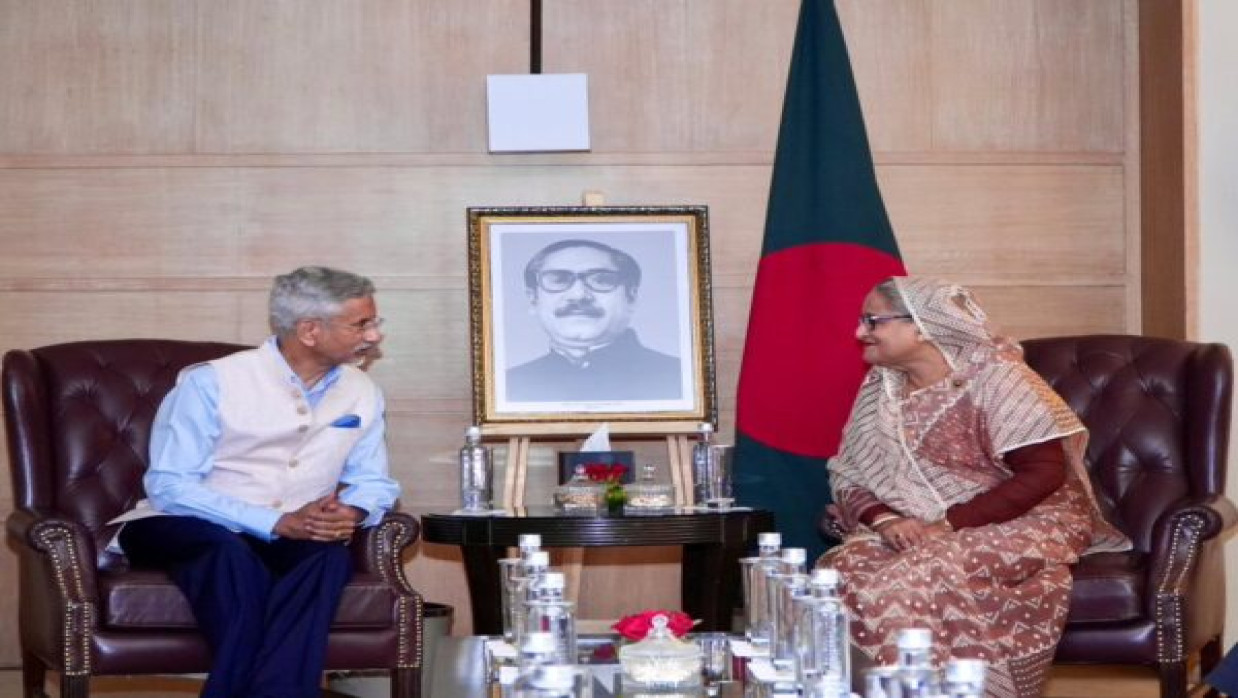
For several decades, India’s relationship with Bangladesh was rigidly linear: trust the Awami League (AL), invest in AL chief Sheikh Hasina, and assume that political stability in Dhaka depended on the continuity of one ruling party.
That strategy has now collided with reality after last year’s mass uprising, which ended the dictatorial regime of Hasina. Two recent developments — Indian Prime Minister Narendra Modi’s warm public wish for the ailing Bangladesh Nationalist Party leader and former Prime Minister Khaleda Zia, and External Affairs Minister S. Jaishankar’s notably neutral comment on Hasina’s stay in India — suggest that New Delhi is finally reassessing the costs of a one-party policy.
Modi expressed “sincere prayers” for Zia and said India “stands ready to extend all possible support” to the BNP chairperson, who is in critical condition.
His message to Zia seems to stem from something more than courtesy, and analysts across the region quickly detected its political weight. This was widely interpreted as symbolic but deliberate outreach — a signal that India is ready to have a warm relationship with the next Bangladesh government, which at this moment seems likely to be formed by Zia’s BNP.
Reports in Indian outlets also noted that such an outreach could indicate pre-poll repositioning, a tacit acknowledgement that a sustainable relationship with Bangladesh cannot be tied to a single party’s fortunes.
The shift became more visible when Jaishankar addressed a question about how long Hasina could continue staying in India, where she fled last year after her abrupt exit from power.
Instead of the protective, politically loaded framing that once characterized India’s public messaging on Hasina, Jaishankar stated simply that she came “in a certain circumstance” and now “has to make up her mind.”
This neutrality — almost studiously non-committal — contrasts sharply with India’s earlier stance. For a decade, New Delhi often appeared to conflate Bangladesh-India friendship with support for AL rule. Now it seems to be signaling that it does not intend to act as the guarantor of Hasina’s political future.
These developments matter because India’s previous approach has backfired in ways that are now impossible to ignore. By investing almost exclusively in the AL, India alienated vast sections of Bangladeshi society.
It allowed grievances to accumulate – unaddressed disputes like that over sharing of the Teesta’s waters, long-standing complaints about trade imbalance and non-tariff barriers, recurring border killings, and the perception that India exercised undue influence over Bangladesh’s internal politics.
These issues metastasized into a broader resentment. As multiple analyses have noted, the 2024 youth-led uprising that toppled Hasina was not just a domestic political reckoning — it was also, implicitly, a rejection of external actors seen as complicit in enabling an unaccountable system.
This resentment has been visible in growing anti-India sentiment across Bangladesh. It stems from lived experiences. Many Bangladeshis feel India benefits asymmetrically from trade, that unresolved river disputes reflect Indian high-handedness, that the Border Security Force’s lethal enforcement along the frontier treats Bangladeshi lives as expendable, and that New Delhi’s partisan involvement distorts the country’s political process.
The rise of majoritarian Hindutva politics in India has added a cultural edge to these perceptions, fueling anxiety among segments of Bangladeshi society. The picture that emerges is clear: people do not dislike India as a neighbor; they dislike a lopsided relationship.
No external actor —not China, not Pakistan, not the Gulf, not Western partners — can replace the unique geographic and historical closeness between the two. If New Delhi wants to protect these interests, its relationship with Dhaka must be broad-based.
A healthier approach would involve genuine political neutrality and institutional engagement with all major forces — from the BNP to Jamaat-e-Islami to the newly formed National Citizen Party (NCP) to emerging civil society actors. India must demonstrate that it respects Bangladesh’s sovereignty and internal political processes.
Addressing structural grievances is equally important: concluding water-sharing agreements on the Teesta, reducing non-tariff barriers, ensuring humane border management, and fostering fairer economic cooperation. A relationship that benefits Bangladesh tangibly will automatically generate goodwill for India.
A bilateral relationship also requires Indian media and political discourse to handle Bangladesh with nuance rather than sensationalism or condescension. Rhetoric that frames Bangladesh solely through security or migration lenses feeds resentment.
Conversely, Dhaka too must navigate nationalist emotion responsibly by distinguishing between legitimate grievances and counterproductive anti-India populism.
Both the country’s leaderships need to understand that Bangladesh’s internal transformation after 2024 has made the old formula obsolete. A partner that is democratic and sensitive to public opinion cannot be approached with a one-party strategy.
If New Delhi uses this opportunity to craft a more respectful, mutually beneficial, and people-centric approach, the anti-India sentiment that grew in Bangladesh over the past decade can be reversed. Trust can be rebuilt. A partnership shaped by equality, not patronage, can emerge. And the bilateral relationship — one of the most important in South Asia — can shift from fragility to resilience.
The article appeared in the thediplomat

0 Comments
LEAVE A COMMENT
Your email address will not be published