

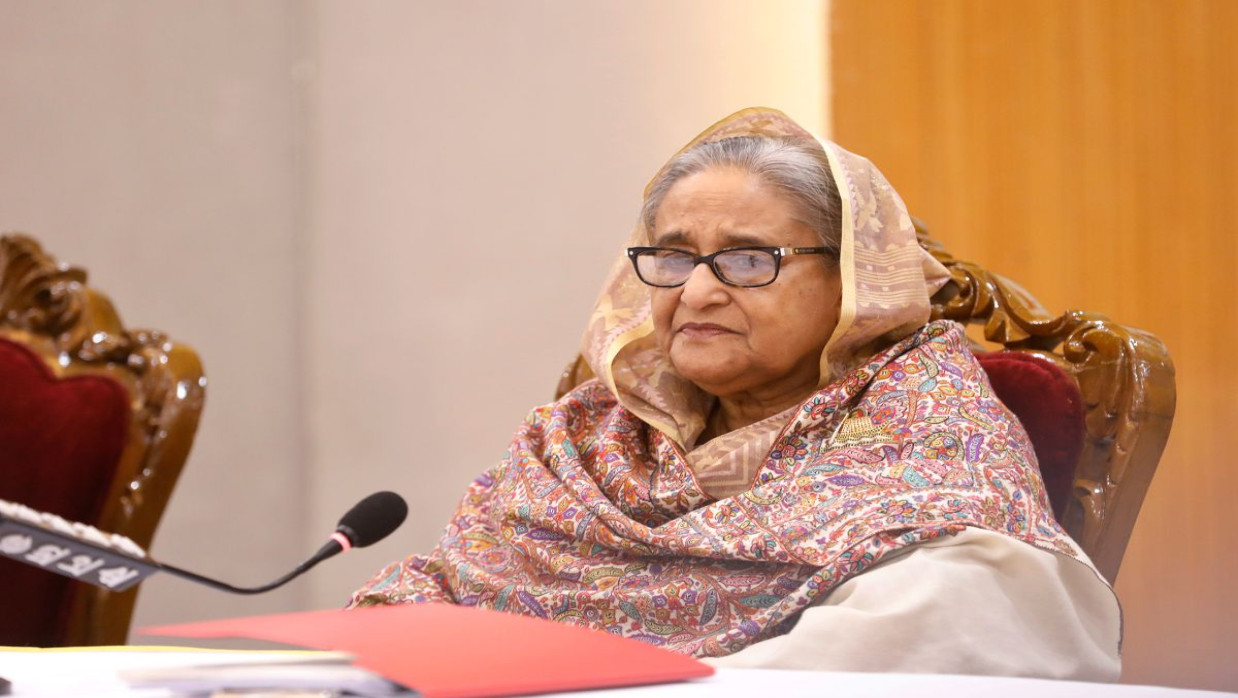
A groundbreaking ruling that has no parallel in Bangladesh’s legal history
Bangladesh Verdict Verdict: Bangladesh’s International Crimes Tribunal-1 has yesterday (17 November 2025) sentenced deposed Prime Minister Sheikh Hasina and former Home Minister Asaduzzaman Khan Kamal to death by hanging in absentia for the crimes of genocide and crimes against humanity committed in July–August 2024 during the nationwide uprising.
Bangladeshis embraced the verdict with a sense of vindication and relief. For some, a chapter had finally closed. For many, it is a moment that will define Bangladesh, and the start of an excruciating national process of soul-searching. For Chief Prosecutor Tajul Islam, there was one message the verdict sent above all others: Power does not absolve criminals of the need to answer before the law.
Bangladesh Verdict Center: A case against the main perpetrator of state violence
At the center of the prosecution’s case against Sheikh Hasina was a theory that sought to painstakingly establish not only her implication, but to place the deposed Prime Minister very much at the epicenter of the violence. Tajul Islam referred to her as “the axis of all crimes against humanity that were committed during the uprising,” and the presentation painted not of a leader guiding a nation through a moment of crisis, but rather, a powerful dictator intoxicated by power.
In that context, the violence that engulfed Bangladesh through July and August 2024 was not an anarchic explosion of the people, but an act of state violence that was calculated and carried out with chilling precision, following a clear chain of command from the top. The courtroom heard eyewitness testimony. Forensic and digital evidence. Telephone recordings. The transcript read in open court, according to the prosecution, included Hasina herself ordering the use of live ammunition and helicopter attacks against protesters. For Tajul Islam, it amounted to evidence that “the only aim of the heinous crimes committed during the uprising was to cling to power at all costs.”

Image source: YouTube
Bangladesh Verdict Stage set for the tribunal to charge her of superior command responsibility.
With that, the stage was set for the tribunal to build on the theory of superior command responsibility – the argument that Hasina, aside from simply overseeing and ordering a deadly crackdown, had deliberately set in place a policy of lawlessness and violence, and that it was this policy that was Hasina’s chosen means to stay in power at all costs.
Bangladesh Verdict A Ruling: A thorough, detailed verdict
The courtroom was filled to capacity when, at 12:34 p.m., the Tribunal Chairman, Justice Golam Mortuza Mojumdar, began reading the 453-page judgment. Justice Shafiul Alam Mahmud and retired Judge Mohitul Haque Enam Chowdhury flanked him on a side. The tribunal’s meticulous, thorough verdict first detailed the prosecution’s evidence, the defense’s presentation and rebuttals, and the tribunal’s own findings and investigation.
The 453-page report examined not only 2024 but also Bangladesh’s broader political landscape over the past 15 years. It relied extensively on the accounts of journalists, intellectuals, family members of victims, and the international human rights community. Among its observations: consistent repression and intimidation across Hasina’s 20 years in power; an entrenched culture of fear. The report also noted state-sponsored violence, extrajudicial killings, and enforced disappearances. In its words, authoritarianism pushed many Bangladeshis into exile, and elections have been deeply compromised, with democratic rights trampled in the process.
In a forceful observation, the tribunal described three national elections as deeply flawed and of questionable veracity: 2014, 2018, and 2024.
Bangladesh Verdict Ruling: A thorough, detailed verdict
Bangladesh progressed by leaps and bounds after the separation in 1971
The tribunal described the events of July–August 2024 as a “crime of exceptional gravity” in which Bangladesh “moved forward by leaps and bounds” after the separation in 1971. The defendants could “expect the people of the country to remain silent forever and try to erase the history by murdering the people of the country,” but the tribunal will “deliver justice and write the history with its own ink.”
“The offenses were far from being random or spontaneous,” read the ruling. It pointedly described not only Hasina and Kamal’s role in state violence and order-giving but also castigated “the culture of impunity” that allowed Bangladesh politicians to “violate human rights and institutionalize injustice with immunity” in the country for so long.

The Chief Prosecutor, Tajul Islam, addresses the media
Bangladesh 5 out of 7 charges proven beyond a reasonable doubt
In the end, the tribunal ruled that 5 out of the 7 charges brought against Hasina had been conclusively proven. The inflammatory speech that has now earned her a life imprisonment sentence has helped stoke tensions and created the conditions for violence. The other charges all explicitly tied Hasina to the killings in Rangpur, Chankharpul, Ashulia, and a chain of command during the days leading up to and after the nationwide uprising.
The acts, ruled the court, were not incidental, not the spontaneous excesses of unruly protests. Instead, the tribunal found, these events had been well-organized, intentional, and institutionally planned acts of state-sponsored violence and repression. The tribunal ruled that the “only sentence which can be awarded is capital punishment.”
Bangladesh wholeheartedly embraced the Bangladesh verdict
The verdict came out at 2:45 p.m. Inside the courtroom, relatives of July’s martyrs wept, embraced, and paid remembrances of the dead. On campuses and town squares, students passed sweets, hugged, and celebrated a verdict many described as long-awaited justice.
Bangladesh’s political opposition parties, who had long spoken out against the country’s democratic backsliding, BNP, Jamaat-e-Islami, NCPC, and others, openly welcomed the verdict. The interim government urged the public to maintain calm, to show strength and resilience in the face of the events of the past days, and to reject any provocation or attempts to sow disorder. The message from all sides was clear: justice has been done, but public order must be preserved.
Bangladesh victims’ families, however, want to see more
The families of victims, however, want to see more. They are calling for the fugitives, Hasina and Kamal, currently sheltering in India, to be returned to face justice in Bangladesh. The interim government has signaled its support for the idea. Foreign Affairs Adviser Towhid Hossain issued an official statement calling on the Indian government to honor its obligations by returning the fugitives and warning that a failure to do so would be deeply resented in Bangladesh.
Bangladesh: Setting precedents by walking on the path of international criminal accountability
Bangladesh Chief Prosecutor Tajul Islam, addressing the media after the announcement of the verdict, said, “An era has ended today.” “This trial,” he added, “was held in accordance with international standards, and if there are objections, then this can be investigated in any international court in the world.” He stressed that the verdict was not an outcome of a revenge mission but of justice.
The prosecution had set itself a very difficult task to prove charges of crimes against humanity, to bring into the light a decade and a half of state oppression and abuse, and to make the case for a public figure who no longer resided within the court’s reach. Tajul Islam described it as an end to a long era in which Bangladesh was hobbled by impunity, in which powerful figures abused their positions of authority and shielded one another from judicial scrutiny through political patronage, institutional manipulation, and diplomatic sanctuary in foreign countries.
Bangladesh made international criminal trials necessary, and the tribunal’s ruling was neither revolutionary nor precedent-setting. Still, it confirmed that Bangladesh was an independent nation with the institutional capacity and moral clarity to investigate and adjudicate difficult crimes against humanity.
Bangladesh long endured impunity for power and abuse
Bangladesh has long endured a decades-long and challenging legacy of impunity for power and abuse
Responding to a question about the possibility of an appeal, Tajul Islam read from the tribunal’s verdict, explaining that the law grants the convicted 30 days to surrender. In the absence of a surrender or arrest, the law is explicit that no appeal is possible, in any court, anywhere in the world.
Bangladesh Attorney General Asaduzzaman said it was one of the most important verdicts in the country’s history. All movable and immovable properties of both Sheikh Hasina and Asaduzzaman Khan Kamal should be seized, he added. The money would be given to the families of the deceased and injured, he said.
Bangladesh, however, has warned the fugitive Hasina that no appeal can be filed in the absence of the accused’s physical presence.
Bangladesh Legal Adviser, Professor Asif Nazrul, has issued a more expansive call for the return of the fugitives. He praised the verdict as the “highest form of justice” for victims, and urged India to live up to its obligations by handing over the fugitives to Bangladesh.
Bangladesh made a new step in international accountability
Nazrul warned that India providing political asylum for persons convicted of genocide would be treated as an act of aggression and hostility towards Bangladesh. He reminded the interim government that the wheels of justice in Bangladesh must now turn at full speed and with no further interruption or delay.
Bangladesh’s future: Looking ahead. The verdict has broader implications for the country’s future. Justice and accountability are part of the solution, but political healing, reconciliation, and recommitment to democratic institutions must also be integral to the process. For Bangladesh, the judgment is a new step in a longer process. The course of the nation’s future trajectory has yet to be written. A state can convict a person, but only strong institutions can make the sins of the past a history.
India’s role now carries a huge responsibility
India now has the ability to shape the future of Bangladesh-India relations for years to come. Should the Indian government honor the verdict, it will demonstrate its respect for Bangladesh’s sovereign judicial processes and the maturity of its democratic institutions. If not, it will be complicit in harboring a person found guilty of serious international crimes and crimes against humanity.
Politics often works in broad strokes, and it can be more forgiving of political calculation than moral calculus. But this moment in Bangladesh demands moral clarity and political courage. India is not immune to international law, and extradition or repatriation, especially of someone accused of serious international crimes, is always a diplomatic test.
Bangladesh is a nation at a historic crossroads
Bangladesh now finds itself at a historic crossroads, between the memory of the past and the promise of a future. The uprising was not a political, but a rupture born of a legacy of unredressed grievances, of a decade and a half of systemic repression, and of deep state violence that, in the end, could not be controlled or contained by the government. The verdict offers a measure of closure, but the work of rebuilding trust in institutions and political life, of healing the divisions of a nation, and restoring democratic legitimacy remains only just beginning.
Bangladesh Verdict: The trial of Sheikh Hasina may be over, but a larger process of trial has just begun. The prosecution of Bangladesh’s institutions and governance culture, its democratic resilience, and political DNA. Whether this moment becomes a lasting turning point or a tragic, temporary aberration from Bangladesh’s otherwise promising trajectory will be the work of years, of a new generation of Bangladeshis.
Bangladesh: The verdict is a fight for a just republic
Bangladesh, from the very moment of its birth, has always been a nation fighting for justice, dignity, and democratic values. In this singular moment, Bangladesh has a choice: to be consumed by the past or to look to the future with courage. The verdict of today is not the end of the story, only the start of a new chapter in Bangladesh’s unfinished project for a just republic.


0 Comments
LEAVE A COMMENT
Your email address will not be published