

President Trump’s strong support for Israel’s defence posture in the Middle East reflects Washington’s long-standing pro-Israel doctrine, under which Israel is treated as America’s central military, intelligence and strategic partner in the region. This approach has enabled Israel to act with considerable military freedom while the United States provides diplomatic cover, advanced defence support and political backing against Iran and other regional actors. For Trump, defending Israel is not merely an alliance commitment; it is a deliberate strategic choice aimed at preserving American influence, deterring Iran, reassuring Gulf partners and satisfying powerful domestic pro-Israel constituencies. However, Israel’s aggressive military posture and Washington’s unconditional support have widened the conflict beyond the battlefield. Once Iran used the Strait of Hormuz as an economic pressure point, the crisis shifted from Israel’s security narrative to a broader threat against global energy flows, maritime stability and the world economy.
For decades, the United States was the dominant player in this strategic game. Its greatest instrument was not only military power, but the U.S. dollar. Because oil, commodities, banking settlements and global reserves are deeply tied to the dollar, Washington could sanction rivals, freeze assets and restrict access to international finance. The Council on Foreign Relations notes that the dollar’s centrality gives the U.S. exceptional sanctions power because dollar transactions normally pass through U.S.-linked banking infrastructure.
Iran’s response has exposed the limits of that financial weapon. By disrupting or effectively closing the Strait of Hormuz, Tehran has turned geography into an asymmetric economic weapon. The Strait is not just a regional waterway; it is one of the world’s most critical energy chokepoints. The U.S. Energy Information Administration estimated that in 2024, around 20 million barrels per day of oil moved through Hormuz, equal to about 20 percent of global petroleum liquids consumption. The International Energy Agency has described the recent disruption as a historic shock, noting that traffic through the Strait has been essentially halted and that resuming flows is the single most important factor for easing pressure on energy supplies, prices and the global economy.
This is where the U.S.-Israel strategy faces its biggest failure. Military superiority can hit targets, but it cannot easily reopen a maritime chokepoint if regional actors are ready to keep escalating. The U.S. and Israel may dominate the air and sea militarily, but Iran has shown that even a weaker military power can impose global costs by weaponizing economic interdependence. In this sense, the conflict has become a contest between hard power and chokepoint power.
Reducing the world’s dependence on Hormuz is extremely difficult. Saudi Arabia has pipeline access to the Red Sea and the UAE can move some crude to the Gulf of Oman, but these routes cannot fully replace the volume carried through Hormuz. The EIA has noted that Saudi and UAE pipelines provide some bypass capacity, but most volumes moving through Hormuz have no alternative route.
The modern global economy is dangerously dependent on chokepoints. Countries are already trying to reduce similar vulnerabilities in other sectors. The U.S., Europe, Japan and partners are investing in mining, refining and supply-chain alternatives outside China, particularly for rare earths, batteries, solar technology and critical minerals. Reuters also reported that Australia and the U.S. committed more than A$5 billion to critical mineral projects to counter China-dominated supply chains.
In this environment, Pakistan’s mediation role becomes both timely and positive. Pakistan has direct geographic, cultural and religious proximity to Iran, while also maintaining working channels with the U.S., Gulf states and China. Field Marshal Syed Asim Munir’s role is especially significant because military-to-military credibility matters in a conflict involving deterrence, escalation control and regional security. Al Jazeera reported that Field Marshal Asim Munir visited Tehran as part of mediation efforts to end the U.S.-Israel war with Iran and that Islamabad had helped secure a temporary ceasefire and hosted high-level U.S.-Iran talks.
Pakistan’s Interior Minister Mohsin Naqvi’s Tehran visit, carrying messages from Pakistan’s military and political leadership, shows a coordinated national approach. Naqvi met Iran’s foreign minister in Tehran as Islamabad stepped up mediation and that he said he was carrying a special letter from Field Marshal Asim Munir and a message from Prime Minister Shehbaz Sharif for Iran’s Supreme Leader.
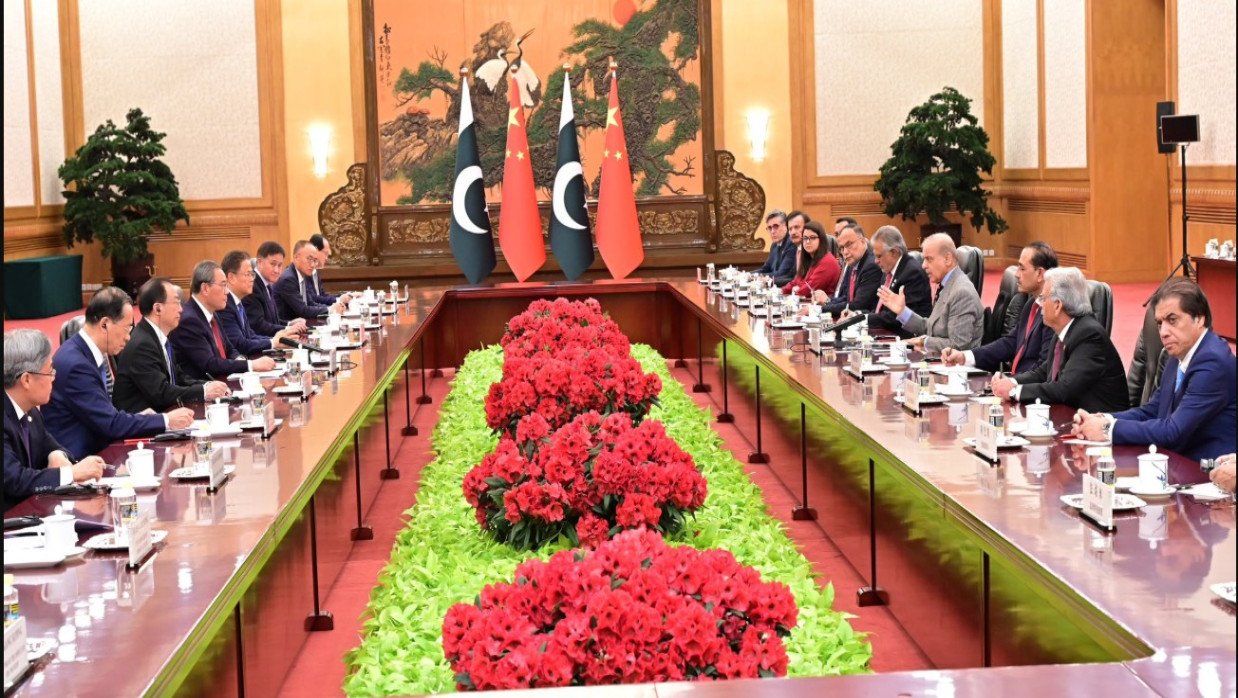
Pakistan’s mediation becomes even stronger when coordinated with China. Pakistan and China should be seen by Iran as brotherly states, not hostile intermediaries. Both have strategic respect for Iran’s sovereignty, both understand the consequences of regional war and both have deep stakes in the security of energy routes. A Pakistan-China framework can offer Iran dignity, the U.S. an exit and the region a pathway away from escalation.
The urgent need is not another military round, but a diplomatic architecture that protects Iran’s legitimate security concerns, reopens Hormuz, stabilizes energy markets and prevents the Middle East from sliding into a wider war. Pakistan, guided by Field Marshal Asim Munir’s peace-oriented outreach and supported by responsible political officials, can work with China to create that opening. This is not weakness; it is strategic maturity. In a world where interdependence itself has become a weapon, peace diplomacy is now the most powerful defence of regional and global stability.

0 Comments
LEAVE A COMMENT
Your email address will not be published